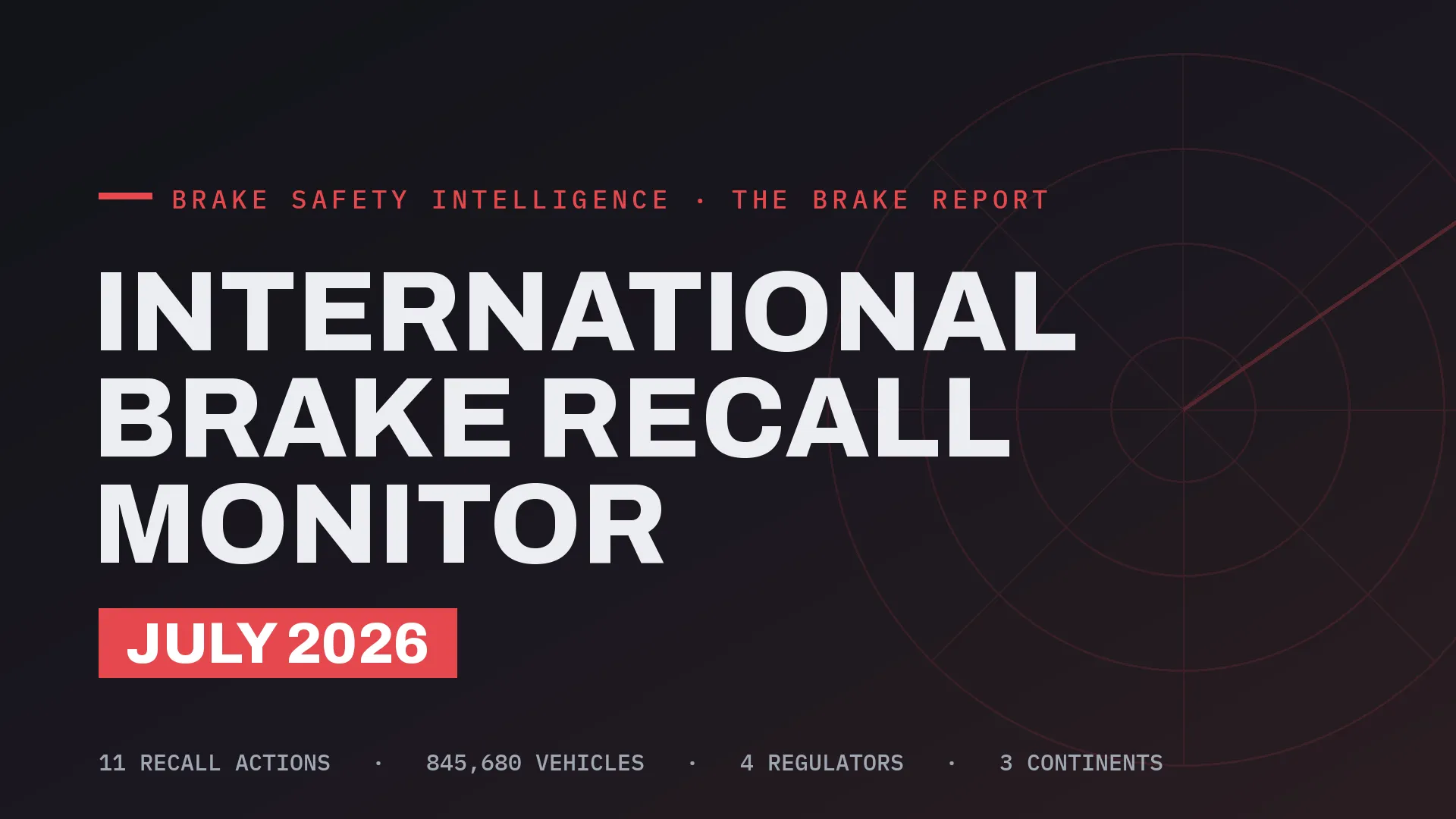

July’s international brake recall picture resolved a question we have carried for three editions. Korea confirmed a domestic fix for Hyundai’s phantom-braking defect. Meanwhile, Mercedes-Benz filed the month’s largest single action, and Japan’s register gave up a 405,963-unit catch-up item. Our monthly sweep covered Transport Canada, the EU Safety Gate, Germany’s Kraftfahrt-Bundesamt, car-recalls.eu, Japan’s MLIT, and Korea’s MOLIT. Here’s what brake industry professionals, aftermarket distributors, and fleet operators need to know.
Korea closes the Hyundai phantom-braking loop
The watch item is resolved. Korea’s Ministry of Land, Infrastructure and Transport confirmed a voluntary correction covering 104,781 Tucson and Tucson Hybrid vehicles for the Forward Collision-Avoidance software deficiency behind Hyundai’s US phantom-braking campaign. Repairs began July 30.
The Korean scope tells its own story. Domestic builds from July 2023 through March 2026 are covered — a window reaching two model years earlier than the 2025–2026 population Hyundai filed with NHTSA. The FCA software, tied to front cameras supplied by Mobis, can misjudge a collision threat and brake when it shouldn’t.
We flagged this gap in the May edition and checked the Korean and Japanese registers again in June without finding a follow-on. Korea has now acted. Japan still has not: Hyundai’s only July filing at MLIT covered a cooling-system valve on the INSTER, not brakes. That half of the watch item carries forward.
Mercedes-Benz: the parking brake that never knew you left
The month’s largest action came from Mercedes-Benz. The company is recalling 310,667 vehicles across seven model lines under NHTSA campaign 26V481, spanning the 2019–2026 A-Class, CLA, C-Class, CLE, GLA, GLB, and GLC.
The defect sits nowhere near the brake hardware. A microswitch in the driver’s door lock can corrode from moisture ingress and stop reporting that the door has opened. The electronic parking brake and Auto-Park function — designed to engage automatically when the driver exits — then silently do nothing. Mercedes estimates a 100 percent defect rate across the population.
The early warning is telling. Drivers may notice comfort symptoms first, such as the radio staying on after exit, before any braking symptom appears. 176 US field cases were logged between March 2021 and June 2026, all comfort-function related, with no US rollaway reported. Dealers replace the door lock assembly. Notably, no Transport Canada or KBA parallel had published at press time — a new watch item for a defect that should not respect borders.
A 405,963-unit catch-up from Japan
Japan’s register produced the sweep’s biggest surprise, and it was hiding in March. Daihatsu filed MLIT recall 5791 on March 27, covering 405,963 Move, Wake, Stella, Pixis Mega, and Hijet Caddy vehicles sold under the Daihatsu, Subaru, and Toyota badges. The filing landed during the register’s spring maintenance outage and never surfaced in our earlier sweeps. We are adding it now, as a catch-up item.
The defect is old-school hardware. An improperly assembled cowl louver water seal lets rain drip onto the brake booster. Corrosion can eventually perforate the booster shell, increasing pedal effort and stretching stopping distances. Workshops inspect each vehicle and apply anti-rust treatment, replace the seal, or replace the booster outright. Together with June’s Hyundai i20 vacuum hose action in Germany, it makes two consecutive months of large vacuum-booster recalls — a reminder that legacy hardware still generates seven-figure exposure while software dominates the headlines.
ZF brake module pattern widens at Stellantis
Stellantis logged its second brake-control-module recall of 2026 tracing to ZF-supplied hardware. Chrysler is recalling 11,980 Jeep Grand Wagoneer and Grand Wagoneer L SUVs under NHTSA campaign 26V414 and FCA recall 50D.
Suspect Brake System Control Module software inside the ZF brake booster and master cylinder assembly can disable electronic stability control and electronic brake assist, out of compliance with FMVSS 126 and 135. FCA estimates a 100 percent defect rate, with no warning before failure. The remedy is a software reflash.
The component lineage matters. April’s 241-unit Jeep Cherokee recall involved a ZF-supplied BSCM with the same failure signature — disabled stability control from suspect module software. Two nameplates, one supplier, one defect family. Suppliers and fleet buyers should watch whether the pattern extends further across the Stellantis lineup.
The Shyft chassis defect cascades downstream
June’s Shyft Spartan RV chassis recall has now propagated to the motorhome builders. Jayco recalled 265 Entegra Cornerstone, Aspire, Anthem, Reatta, and Reatta XL motorhomes under campaign 26V484, and Foretravel recalled 69 Realm Presidential coaches under 26V486. Both actions cover coaches built on the affected Spartan K-series chassis.
The defect is unchanged from the chassis-level filing: a brake pressure switch can leave the exterior brake lights illuminated when the driver is not braking, failing FMVSS 108. Both builders will replace the pressure switch, working with Shyft. It’s a textbook example of how one Tier 1 chassis defect multiplies into separate OEM campaigns — worth remembering when tallying the true footprint of any chassis-level action.
North American commercial and powersports actions
School bus fleets lead the commercial file. Blue Bird is recalling 5,125 Vision school and transit buses under two linked campaigns, 26V466 and 26V467. An exhaust hanger clevis-and-cotter-pin kit can migrate into contact with the hydraulic brake line and wear through it. Leaking fluid near hot exhaust adds a fire risk on top of longer stopping distances. Transport Canada carries the parallel as recall 2026351.
KTM North America filed the month’s sharpest advisory. The company is recalling 6,257 Husqvarna and GASGAS motorcycles under campaign 26V443 because the rear brake caliper’s primary pin casting can crack when the bike rolls backward. NHTSA attached a Do Not Drive advisory. It is the second off-road caliper-casting recall of the year, after BRP’s Can-Am Origin action in April.
BMW filed a recall of a recall. Campaign 26V422 covers 428 vehicles that did not receive the integrated brake system remedy from earlier recalls 24V-104 and 24V-739 according to specified procedures. The underlying Continental-supplied IBS malfunction can cut power brake assist and compromise ABS and DSC.
Two smaller actions round out the fleet file. PACCAR’s campaign 26V442 covers 8 US Peterbilt 579 and Kenworth T680/T880 trucks whose trailer air brake quick-release valve was installed backwards; Transport Canada’s parallel is recall 2026333, and dealers had already repaired every affected truck before the filings published. And Autocar closed the month by recalling 137 battery-electric E-ACTT terminal tractors under 26V501 for an ABS control unit that may not be properly secured — found when a routine inspection turned up missing fasteners.
A quiet month in Europe — with one big regulatory shift
Europe’s registers went unusually quiet on brakes in July. Our sweep of the Safety Gate weekly batches and the KBA turned up fire, seatbelt, and lighting defects, but no significant new brake campaign. After five straight months of European brake booster and parking brake actions, the pause is notable — though registers often publish on a lag, so August may tell a different story.
The bigger European brake story was regulatory. On July 7, pedestrian-detecting automatic emergency braking became mandatory on every newly registered car and van in the EU. And in the US, NHTSA closed its four-year Tesla phantom braking investigation on July 1 without a recall. Both developments frame the same tension running through this edition: braking behavior is increasingly defined in software, and so are its failures.
What we’re watching
Three items carry into August. First, whether Mercedes files Transport Canada or KBA parallels to the 310,667-unit parking brake campaign. Second, whether Japan follows Korea with a domestic Hyundai FCA action. Third, whether the ZF brake-control-module pattern surfaces in any further Stellantis nameplate.
Campaign reference list
Mercedes-Benz parking brake microswitch: NHTSA 26V481, 310,667 units. Hyundai Tucson/Tucson Hybrid FCA software — Korea: MOLIT voluntary correction from July 30, 104,781 units. Daihatsu/Subaru/Toyota brake booster corrosion — Japan: MLIT 5791, 405,963 units (filed March 27, 2026). Jeep Grand Wagoneer BSCM: NHTSA 26V414 / FCA 50D, 11,980 units; supplier ZF. KTM Husqvarna/GASGAS rear caliper: NHTSA 26V443, 6,257 units. Blue Bird Vision brake line: NHTSA 26V466/26V467 / TC 2026351, 5,125 units. BMW IBS re-remedy: NHTSA 26V422, 428 units. PACCAR trailer quick-release valve: NHTSA 26V442 / TC 2026333, 8 US units. Autocar E-ACTT ABS ECU: NHTSA 26V501 / ACTT-2601, 137 units. Jayco Entegra brake lights: NHTSA 26V484, 265 units. Foretravel Realm brake lights: NHTSA 26V486, 69 units.
Every recall above — plus the full US and international archive — is searchable by supplier, brake system, regulator, region, and vehicle class in our Brake Recall Monitor database. It’s free, and it’s updated every month alongside this report.
Subscribe to The BRAKE Report. Get free sample chapters.