

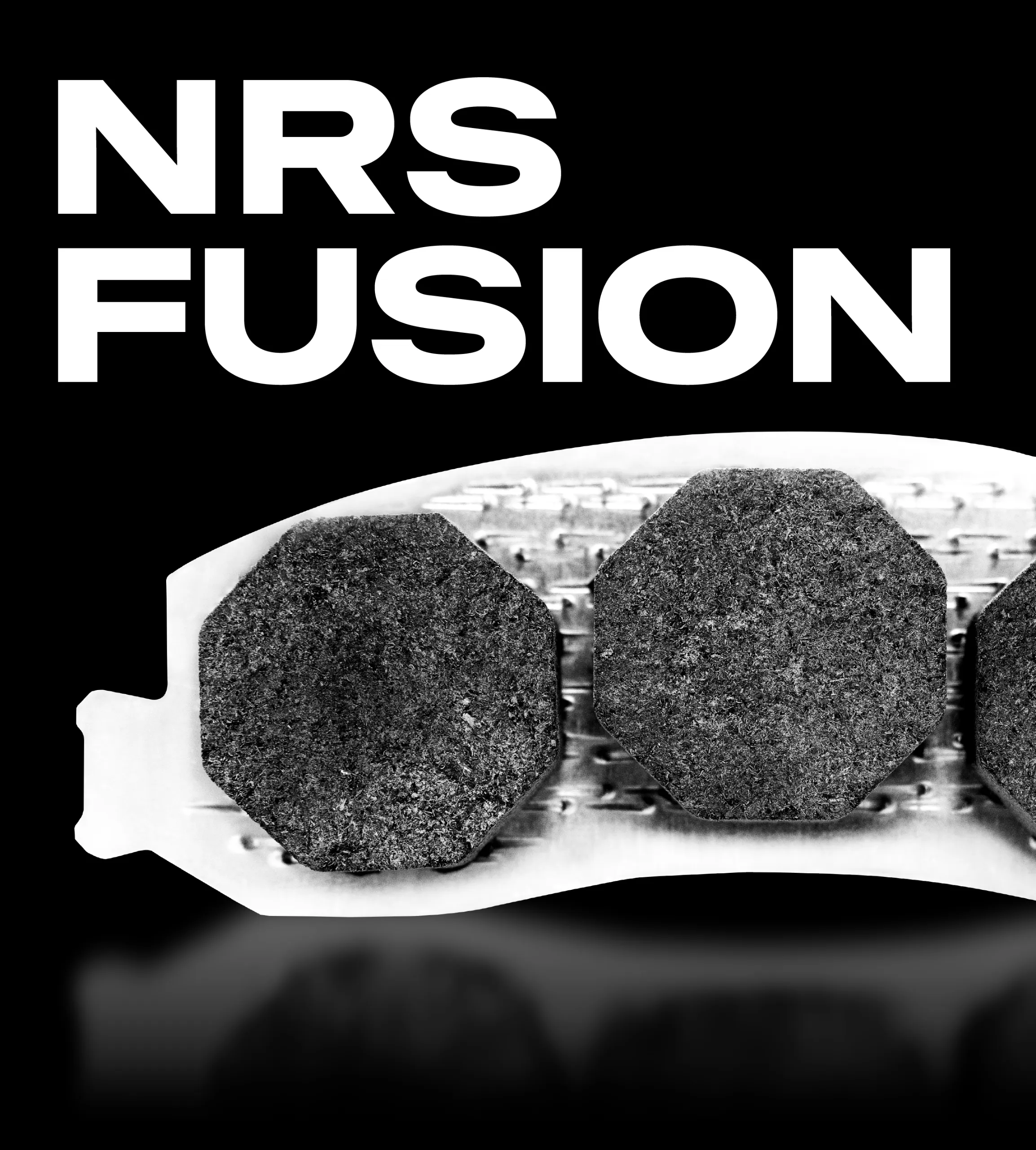
NUCAP Industries will introduce NRS Fusion, a brake pad manufacturing architecture that cures friction material as a separate puck and mechanically presses it into a galvanized steel backing plate, at the 44th SAE Brake Colloquium & Exhibition, September 20–23, 2026, in Palm Desert, California. The developer of the NUCAP Retention System (NRS) describes the approach as a departure from conventional integral molding, in which friction is formed directly onto the plate. According to NUCAP Industries, the process separates friction manufacturing from final pad assembly so that each component can be optimized independently before being joined at the end.
Highlights
- Two-stage build: Friction is manufactured and cured independently as a finished puck, then pressed into a precision, fully galvanized NRS Fusion backing plate.
- Development loop: Engineers can form a puck, fuse it to a consistent plate, test it, modify the formulation, and repeat without changing the steel platform, the company says.
- Multi-formulation pads: NUCAP says different friction formulations can potentially be positioned on different areas of the same pad, including distinct leading and trailing compounds.
- Event details: The company will demonstrate NRS Fusion at the JW Marriott Desert Springs Resort & Spa throughout the September 20–23 event.
How Does NRS Fusion Change Brake Pad Development?
NUCAP frames the primary benefit as occurring before a vehicle reaches production. Traditional brake development, the company says, can require repeated manufacturing cycles as engineers evaluate different friction formulations and configurations.
NRS Fusion creates what the company calls a modular development architecture. Because the backing plate remains constant, engineers can concentrate on testing the friction rather than introducing manufacturing variables into each development loop. NUCAP says this reframes the engineering question from how to manufacture another complete pad for a given formulation to simply which friction to test next.
One Backing Plate, Multiple Friction Options
The company says the architecture opens new possibilities for friction and NVH tuning. Different formulations could be placed on different areas of a single pad, giving engineers a tool for independently adjusting characteristics such as:
- Initial bite
- Wear
- Fade
- Rotor interaction
- NVH
All of this occurs, according to NUCAP, while maintaining the same underlying steel architecture.
Implications Across the Brake Supply Chain
NUCAP positions NRS Fusion as relevant beyond OEM development programs:
- Friction manufacturers: A simpler path from friction chemistry to a finished, mechanically retained brake pad.
- Pad manufacturers: A final assembly architecture combining premade friction, galvanized steel, and mechanical retention.
- Aftermarket: Consolidated friction-puck designs could reduce the need for dedicated friction molds across large numbers of individual applications and help accelerate coverage expansion, the company says.
- OEM and caliper engineers: A platform for faster testing, modular tuning, and reduced development complexity.
Designing the Process Around the Engineer
NUCAP argues that brake pads have historically been designed around the requirements of the manufacturing process, and that NRS Fusion reverses that relationship. Under the company’s model, the friction specialist focuses on friction, the backing-plate engineer on steel, dimensional control, and corrosion protection, and the NVH engineer on configurations and formulations, with friction and steel brought together only when a finished pad is required.
NUCAP will demonstrate NRS Fusion and discuss development opportunities with OEMs, Tier suppliers, caliper manufacturers, friction manufacturers, and brake engineers at the 2026 SAE Brake Colloquium & Exhibition. The BRAKE Report previously covered the event’s call for 2026 presentations, and NUCAP’s earlier launch of its galvanized NRS brake pad line established the mechanically retained, galvanized-plate approach that NRS Fusion builds on.
Subscribe to The BRAKE Report. Get free sample chapters.