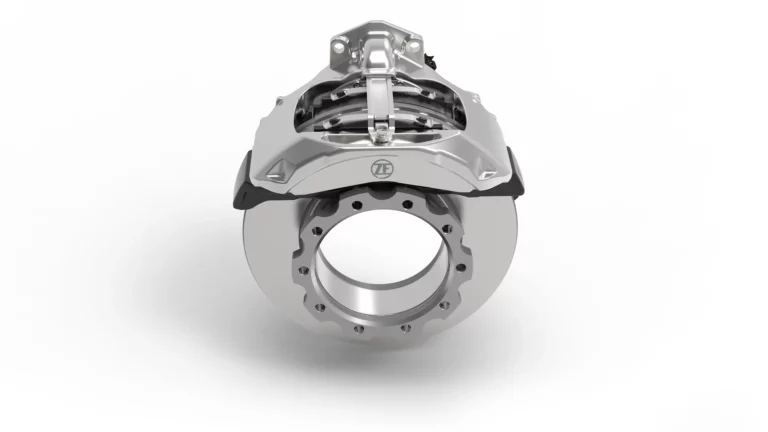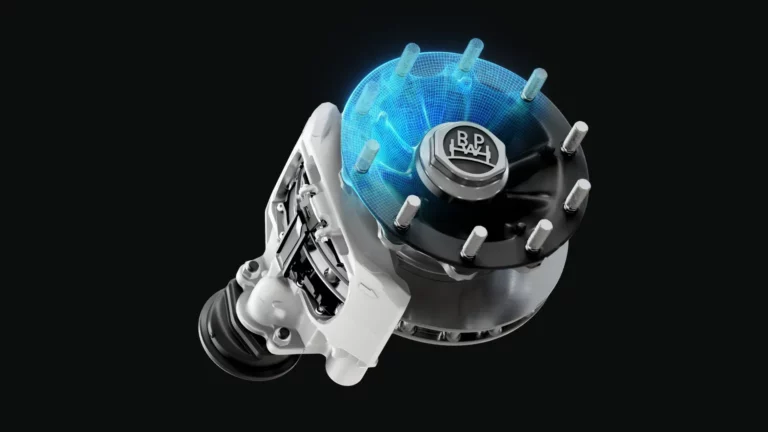


Haldex is extending its single-tappet ModulT disc brake range to trailer axles rated at 24,251 lb (11 tonnes), adding a 19-inch version now and a 22-inch version from October. The company says the ModulT 11-tonne brakes give trailer OEMs a purpose-designed alternative to fitting truck brakes on heavier axles, which the company describes as the long-standing default above the 19,842-lb (9-tonne) class. According to Haldex, the expansion followed a friction-material program in which six of seven candidate compounds failed initial testing.
Highlights
- Two sizes: 19-inch supply began mid-year; 22-inch supply starts in October, per product manager Charlotte Wall
- Disc diameter: the 22-inch brake uses a standardized 430 mm (16.9 in.) disc, which the company says is effectively the ceiling for disc brake applications
- Test temperatures: 1,274°F (690°C) disc temperatures in official testing; above 1,652°F (900°C) in Alpine descent validation
- Fade target: Haldex says it engineers to roughly 25% braking-force reduction hot versus cold, against a 40% legal allowance
Why Haldex Moved Beyond 9-Tonne Trailer Brakes
The company says the 9-tonne axle load has long marked the upper limit of high-volume, purpose-designed trailer disc brakes. Haldex previously offered its twin-tappet ModulX for heavier trailer classes, but that product was not built in high volume, which the company says limited its commercial viability across applications.
“Until today, we have only delivered the ModulT up to 9 tonnes, the normal semi-trailer size,” says Charlotte Wall, product manager at Haldex. “From middle of this year, we will start to supply the 19-inch brake, and from October the 22-inch brake, for 11-tonne axles.”
Haldex first launched the ModulT in 2011, and the company has been adapting the platform beyond its trailer origins in recent years. The single-tappet mechanism lets the caliper be sized for the material volumes required by brake torque and tension, without accommodating two tappets. “A single-tappet mechanism means you can further optimize the design of the casted parts related to required brake torque and tensions require,” says Wall. The company says the result is a lighter, more compact package.
The 11-tonne ModulT shares some spare parts with Haldex’s existing LT range, which the company says supports serviceability and lowers maintenance costs.
No Off-the-Shelf Brake
Despite the shared architecture, Wall says every application requires a customized carrier, which interfaces with the axle, and friction material developed with the disc. The disc is owned by the axle or truck manufacturer, not Haldex.
“The carrier always differs because that takes the interface to the axle, and that is never the same for two customers,” says Wall. The caliper may sometimes be shared across applications, she adds, and that is easier to achieve on trailers than trucks because of trucks’ tighter installation envelopes.
Wall also says trailer qualification requirements have moved closer to automotive standards: “Trailer manufacturers now want evidence for testing, and they want full PPAPs and so on according to the automotive standards – this was not the case 10 years ago.”
How Was the Friction Material Qualified?
For Jonas Benson, Haldex’s friction couple specialist, the main development hurdle was finding a friction material that could survive the 19-inch application.
“The 19-inch is more challenging for the friction material than the 22-inch,” says Benson. According to Haldex, the larger 22-inch disc has more thermal mass to absorb and dissipate heat, while the 19-inch must handle equivalent braking energy in a smaller package.
The company reports that official testing produced disc temperatures of 1,274°F (690°C). The critical measure is fade, the drop in braking effectiveness as temperature rises. Legislation permits a 40% reduction in braking force between cold and hot conditions, but Benson says real-world trailer designs need more margin. “To build a brake system for a trailer with a high centre of gravity that puts a lot of brake load on the front axle, you need more margin than the legal demands,” he says. Haldex says it works to around 25% reduction.
Seven friction materials were screened. Six failed the initial internal test, which the company says mirrors the ECE R-13 standard. The surviving material then faced:
- Disc-crack tests: two run concurrently over two weeks, cycling the disc between hot and cold to simulate long mountain descents
- ISO performance and wear tests: checking consistency between prototype batches and serial-production material
- Alpine test: real-world validation in the Alps, where sustained low-speed downhill driving pushed disc temperatures beyond 1,652°F (900°C)
Benson says bearing grease can vaporize and ignite on the disc under those conditions. “It’s a spectacular test,” he says. “From a brake performance perspective, we find the calliper does what it did before the test and is still clamping with just as much force.”
An authority test at TÜV in Essen, described by Haldex as SAF’s preferred testing partner, preceded two years of field testing. Ten trailers with 19-inch brakes and 10 with 22-inch brakes ran across Europe with inspections every three months. The company says the full process for a new friction material, from screening to production release, takes about three years.
Regulation Now Drives Disc Brake Development
Wall identifies regulation rather than performance as the primary driver for the next phase of disc brake development. The company cites VECTO, which governs how CO₂ emissions from heavy vehicles are calculated, and Euro 7’s forthcoming brake particle limits as shaping its priorities.
“Development of this kind of product is very much driven from regulations at the moment,” says Wall. Drag torque reduction, relevant to VECTO efficiency calculations, is one focus. The phase-out of PFAS (per- and polyfluoroalkyl substances) from brake components is prompting a materials re-evaluation across the product range.
“It meets our demands and it meets customer demands,” concludes Benson.