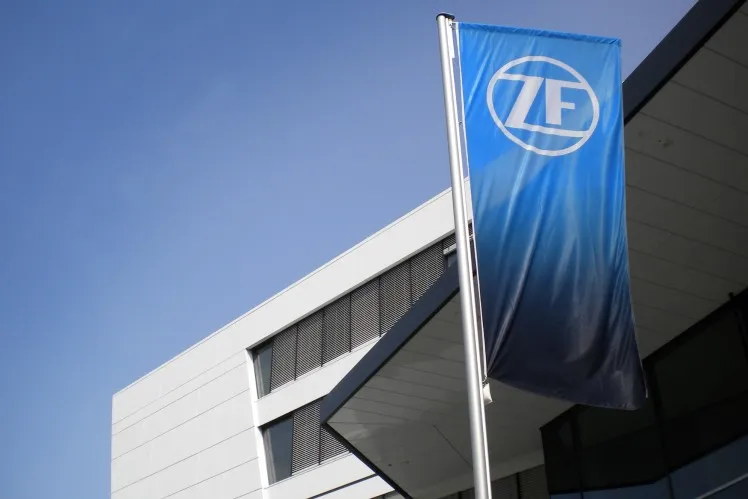

ZF Friedrichshafen AG lifted its adjusted EBIT margin to 5.0 percent in the first half of 2026, up from 4.3 percent in the prior-year period. Adjusted EBIT rose to €964 million ($1.10 billion) from €853 million ($971 million), while sales slipped 2.0 percent on a nominal basis to €19.3 billion ($22.0 billion). The German supplier’s half-year figures show organic sales growth of 0.5 percent once currency and M&A effects are stripped out, alongside a €524 million ($597 million) improvement in adjusted free cash flow to €989 million ($1.13 billion).
Highlights
- Adjusted EBIT margin: 5.0 percent, at the upper end of ZF’s guided 4.0 to 5.0 percent range for the full year
- Sales: €19.3 billion ($22.0 billion), down 2.0 percent nominally but up 0.5 percent organically
- Adjusted free cash flow: €989 million ($1.13 billion), more than double the €465 million ($530 million) of a year earlier
- Net debt: approximately €9.8 billion ($11.2 billion) as of June 30, 2026, with leverage at 2.75x versus 2.98x at year-end 2025
- Workforce: 149,675 employees worldwide, down just over 2 percent from year-end 2025
First-Half Financial Results
| Metric | H1 2026 | H1 2025 |
|---|---|---|
| Sales | €19.3 billion ($22.0 billion) | €19.7 billion ($22.4 billion) |
| Adjusted EBIT | €964 million ($1.10 billion) | €853 million ($971 million) |
| Adjusted EBIT margin | 5.0 percent | 4.3 percent |
| Adjusted free cash flow | €989 million ($1.13 billion) | €465 million ($530 million) |
ZF attributes the cash flow improvement primarily to higher profitability and continued disciplined investment management. “Both factors further strengthened our cash-generation capabilities,” said CFO Michael Frick.
CEO Mathias Miedreich framed the result as evidence that the company’s operating changes are taking hold. “Cost discipline and a stronger focus on operational performance and value-creating products are beginning to deliver results,” he said in Friedrichshafen this week. “The environment remains challenging, but we are making steady progress. Each step improves our performance and strengthens our financial flexibility.”
Spending Discipline and Restructuring Outflows
According to ZF, its narrowed focus on the product portfolio is visible in both development and capital spending. Research and development expenses declined roughly 7 percent to €1.6 billion ($1.82 billion), an R&D ratio of 8.2 percent. Capital expenditure on property, plant and equipment fell about 19 percent to €600 million ($683 million).
Working against the cash flow line were payments tied to restructuring provisions established in earlier periods, part of the restructuring program the company has been executing across its divisions. Those payments exceeded the prior-year level, and ZF describes them as an element of its longer-term transformation.
Debt, Liquidity, and Headcount
Net debt stood at approximately €9.8 billion ($11.2 billion) at the end of June, with leverage improving to 2.75x from 2.98x at year-end 2025. Available liquidity exceeded €7 billion ($8.0 billion), including an undrawn €3.5 billion ($4.0 billion) revolving credit facility that matures in 2029.
Headcount continued to contract. ZF employed 149,675 people worldwide as of June 30, 2026, down just over 2 percent from 153,153 at year-end 2025. The reduction was steeper in Germany, where employment fell more than 4 percent to 47,068 from 49,210.
Full-Year Outlook Confirmed
Frick said ZF remains positioned to meet its full-year 2026 targets, including sales above €38 billion ($43.3 billion). The mid-year margin of 5.0 percent sits at the top of the guided 4.0 to 5.0 percent range. “This demonstrates that our performance program is increasingly gaining traction,” he said. “Together with disciplined cost management and ongoing structural measures, this positions us well to continue improving performance through the remainder of the year.” The company also reiterated its target of more than €1 billion ($1.14 billion) in adjusted free cash flow for the year.
Frick paired that with a caution on market volatility, pointing to geopolitical tensions whose economic effects cannot yet be fully assessed. ZF also notes that anticipated improvements in business conditions in Germany and Europe have not materialized, leaving what the company characterizes as a demanding environment for the automotive industry.
Subscribe to The BRAKE Report. Get free sample chapters.