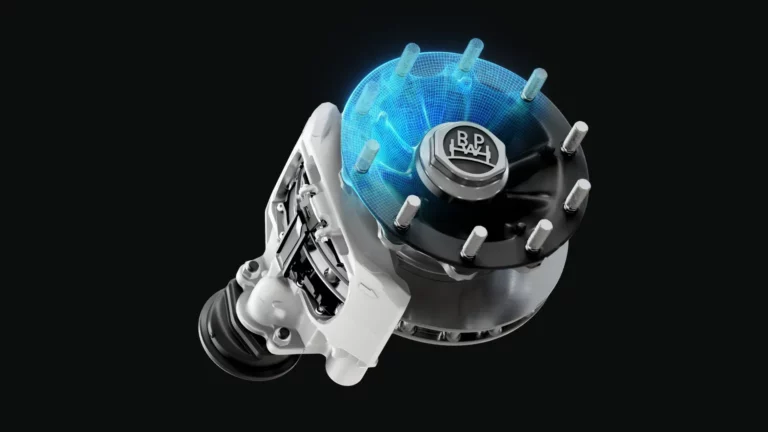


PureForge reported brake particulate emissions of 3.3 mg/km in independent TÜV-Nord testing of its Atomic-Forged rotor process, a figure 53 percent below the 7 mg/km limit that takes effect under Euro 7 on November 29, 2026. The Troy, Michigan-based company announced the result on May 12, citing testing conducted in Germany on a Volkswagen Golf/Jetta brake system fitted with standard OEM rotors processed through Atomic-Forging. The figure also runs approximately 80 percent below conventional cast-iron rotors paired with standard OEM pads, according to PureForge.
Highlights
- Independent TÜV-Nord testing measured Atomic-Forged brake emissions at 3.3 mg/km under the WLTP UN GTR-24 procedure, 53 percent below the 7 mg/km Euro 7 limit for ICE and hybrid vehicles.
- Testing used standard VW Golf/Jetta OEM rotors processed through PureForge’s Atomic-Forging treatment, alongside OE FER8112 pads, suggesting OEM compliance with no rotor requalification or platform redesign.
- PureForge cites more than 1,000 active fleet vehicles and 8 million kilometers of field evaluation, with 47 issued patents protecting the surface-transformation process.
- Sarah Olson, VP of Engineering and Partnerships, will present the full TÜV-Nord dataset at EuroBrake 2026 in Mainz, Germany, on June 2.
Testing Method and Result
The TÜV-Nord evaluation used the WLTP-based UN GTR No. 24 procedure, the test protocol the European Commission has adopted for Euro 7 brake particle compliance. Under that procedure, PureForge recorded 3.3 mg/km of PM10 brake particulate matter from a Golf/Jetta brake system using OEM rotors that had been processed through the Atomic-Forging treatment.
Euro 7 sets a 7 mg/km PM10 ceiling for internal-combustion, hybrid, and fuel-cell passenger vehicles, and a 3 mg/km ceiling for fully electric vehicles. The standard enters force on November 29, 2026, for new vehicle type approvals, marking the first time non-exhaust particulate emissions from brakes and tires have been regulated at the EU level. PureForge’s measured result sits inside the EV-specific 3 mg/km band by a narrow margin and clears the broader 7 mg/km ICE/hybrid threshold by roughly half.
“Euro 7 is forcing the industry to rethink brake design, where many traditional brake systems likely fail Euro 7 limits,” said Sarah Olson, VP Engineering & Partnerships at PureForge. “However, compliance should not require OEMs to accept unnecessary complexity. Our TÜV-Nord results show that Atomic-Forged brakes provide an elegant and scalable path to Euro 7 compliance that preserves performance, durability, and manufacturability.”
Surface Treatment Rather Than Coating
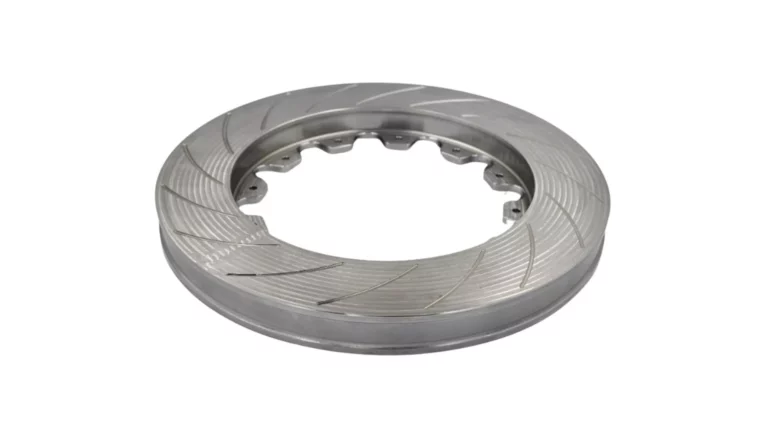
PureForge’s Atomic-Forging process modifies the rotor surface at the micron level by integrating materials into a lattice structure within the cast iron itself, rather than depositing a separate coating layer on top. The company says this distinction is material because coating-based approaches — the dominant industry response to Euro 7 — add machining steps, thermal stress, and interface durability questions that the lattice approach avoids.
That framing positions PureForge against the prevailing OEM solution. Coated brake discs, including hard-metal and tungsten-carbide treatments, are the route most major suppliers have signaled for Euro 7 compliance, with TMD Friction and others identifying hard metal-coated discs as the most promising near-term concept. Bosch has invested more than €1 million in brake-emission test infrastructure aligned to the same PMP-GTR24 specifications PureForge cited.
Industry Context and Compliance Margin
The 3.3 mg/km figure is notable for the headroom it leaves above the ICE/hybrid limit and for clearing the EV-specific 3 mg/km tier only narrowly. Under the current Euro 7 framework, the 3 mg/km ceiling becomes the universal limit across all powertrain types from 2035. A treatment that already sits at 3.3 mg/km on an ICE-derived test platform suggests the technology is closer to the long-horizon limit than to the near-term one — though the result reflects a single brake system on a specific vehicle, not a fleet-wide certification.
PureForge cited internal and third-party testing showing up to 10 times the rotor life and three times the pad life of conventional systems, with deployment across more than 1,000 active fleet vehicles, including police and municipal applications. Those longevity claims are self-reported and not independently verified in the TÜV-Nord scope. The company holds 47 issued patents covering the process and offers a three-year, 160,000-kilometer warranty on treated rotors.
Olson will present the full TÜV-Nord data at EuroBrake 2026 in Mainz, Germany, on June 2 at 1:20 p.m. CET in a session titled “Atomic-Forged Brake Rotor Surface Engineering for Reduction of Non-Exhaust Emissions.”
Subscribe to The BRAKE Report. Get free sample chapters.