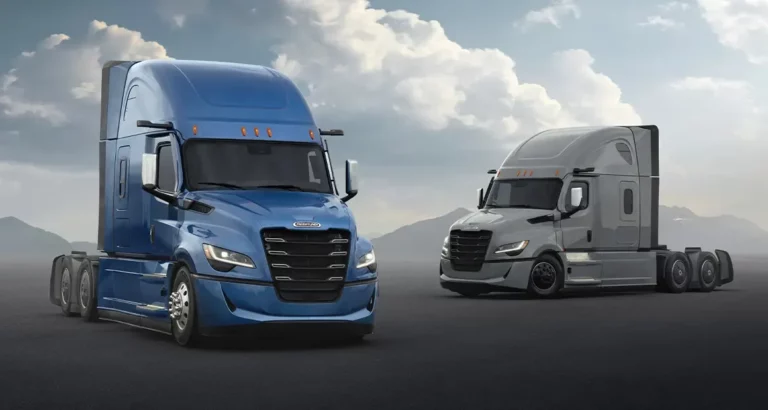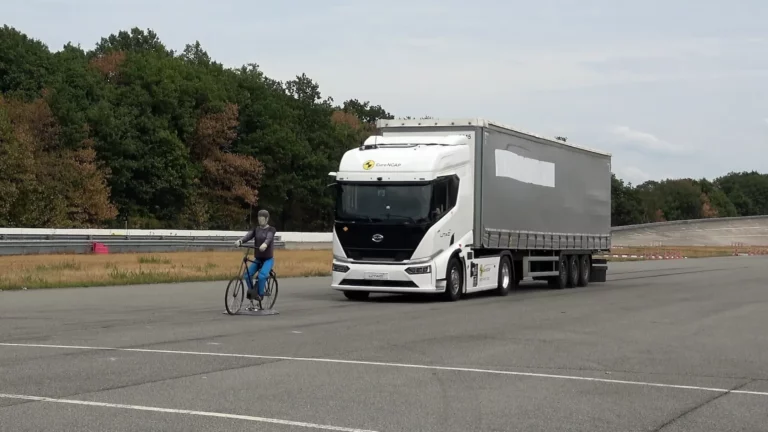
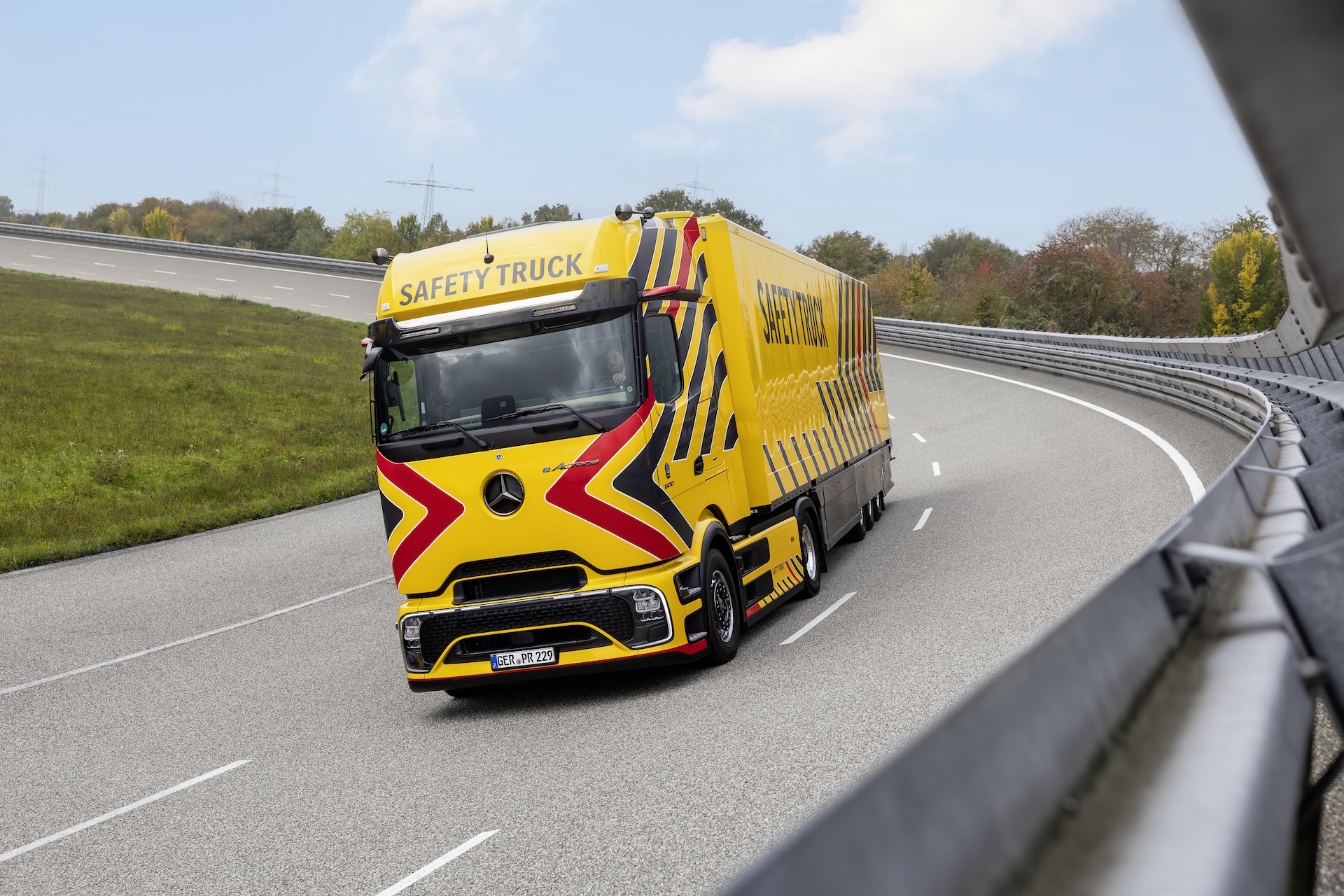

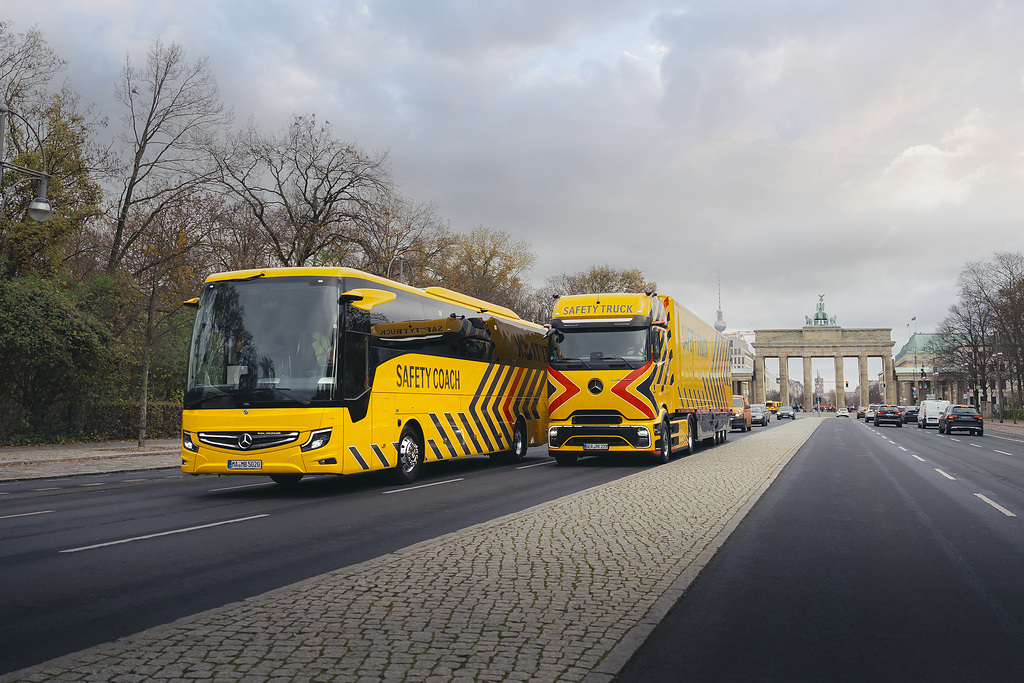
Mercedes-Benz Trucks has unveiled a Safety Truck demonstration vehicle based on the battery-electric eActros 600, equipped with the manufacturer’s current generation of active and passive safety technologies. The vehicle showcases systems designed to address common commercial vehicle accident scenarios, including rear-end collisions, lane departures, side impacts, and blind spot incidents involving vulnerable road users.
Highlights
- Enhanced electronics platform delivers 270-degree sensor coverage with 20 times higher data processing power through fusion of radar and camera data
- Active Brake Assist 6 provides emergency braking for pedestrians and cyclists up to 60 km/h, exceeding July 2026 regulatory requirements
- Active Brake Assist 6 Plus and Attention Assist 2 will launch in February 2026 with capabilities that pre-fulfill future safety regulations
- Passive safety system includes crash energy absorption, upward cab displacement, and automatic high-voltage shutdown in electric vehicles
Advanced Electronics Architecture Expands Detection Range
The Safety Truck incorporates a new electronics platform introduced in the eActros 600 and Actros L. The system combines data from six sensors: four short-range radars positioned front and rear on both sides, one long-range front-center radar, and a multifunction windshield camera.
This sensor fusion architecture provides 270-degree coverage around the vehicle. The platform processes data at 20 times the rate of previous systems, enabling faster response times for automated safety interventions.
Active Brake Assist 6 Addresses Multiple Hazard Types
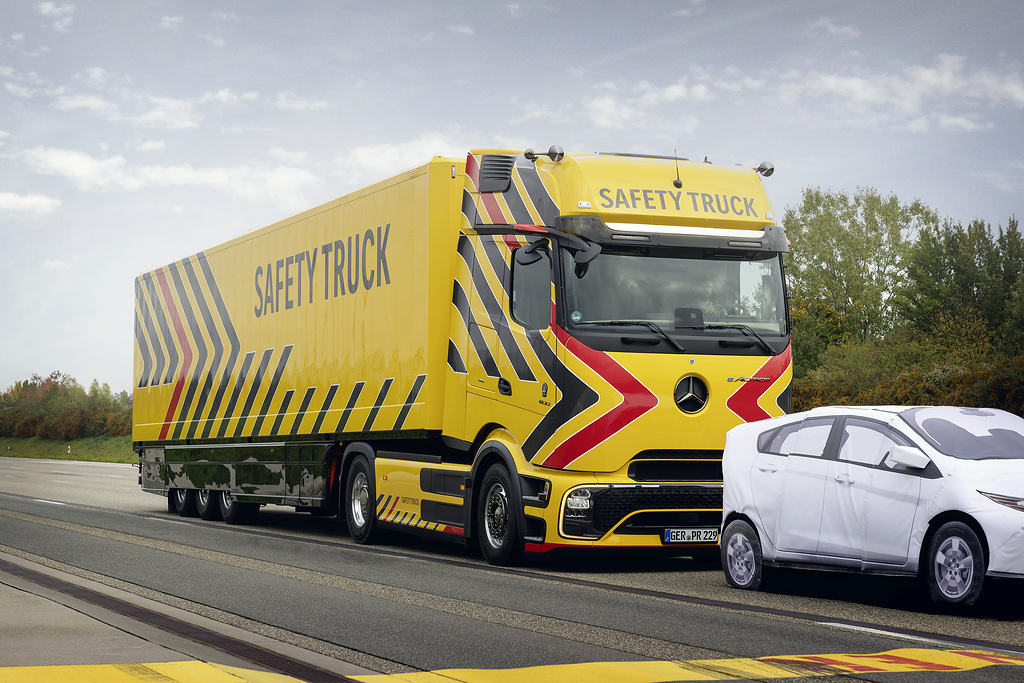
The sixth-generation Active Brake Assist responds to three categories of road users. The system initiates automated emergency braking to standstill at speeds up to 60 km/h for:
- Pedestrians crossing, approaching, or walking in the lane
- Cyclists in the vehicle’s path
- Vehicles ahead at speeds up to 80 km/h
Multi-lane monitoring extends detection range to 250 meters ahead. This capability exceeds General Safety Regulation requirements for pedestrian and cyclist response, which become mandatory for new trucks July 1, 2026.
Active Brake Assist 6 Plus, scheduled for February 2026 introduction, pre-complies with Advanced Emergency Braking System legislation effective September 2028. The enhanced system reacts to vehicles traveling up to 90 km/h and pedestrians or cyclists traveling up to 60 km/h.
Attention Assist 2 Monitors Driver State Through Infrared Camera
The current Attention Assist monitors driver concentration through steering maneuver analysis. When the system detects declining attention at speeds above 60 km/h, it issues visual and acoustic warnings recommending a break.
Attention Assist 2 adds infrared camera-based visual recognition. The system calculates viewing angle and evaluates fatigue indicators including:
- Increased blinking frequency
- Yawning
- Drooping eyelids
- Head and pupil position
All monitoring data remains within the vehicle and automatically deletes after 15 minutes. The system will become available in February 2026.
Active Sideguard Assist 2 Provides Extended Driver-Side Coverage
The second-generation turning assistant monitors both vehicle sides across the complete speed range. On the passenger side, the system covers the legally required area: 30 meters behind and 7 meters ahead at speeds up to 30 km/h.
Active Sideguard Assist 2 employs a two-stage warning system. At speeds up to 20 km/h during right turns, the system initiates automated braking to standstill if the driver does not respond to acoustic and visual alerts. This automated intervention capability exceeds GSR requirements, which mandate warnings only.
The system includes intelligent lane change warnings calibrated to vehicle position within the lane.
Front Guard Assist Monitors Near-Field Detection Zone
Front Guard Assist addresses the blind spot directly ahead of the cab. The system monitors a zone from 0.8 to approximately four meters ahead across the vehicle’s full width.
When detecting stationary or moving objects, the system issues two-stage warnings at speeds up to 15 km/h. The technology supports drivers during stationary periods, vehicle startup, and intersection navigation.

Traffic Sign Assist Provides Real-Time Recognition and Display
The system recognizes and displays traffic signs through combined camera and map data. Traffic Sign Assist identifies:
- Speed limits applicable to trucks
- Overtaking restrictions and their removal
- Warning signs
- Time-based regulation restrictions
Optical character recognition technology processes time limitations within traffic regulations. The multimedia cockpit or classic cockpit displays the two most recently identified signs, with the last recognized truck-specific speed limit shown continuously.
An audible alert activates when the vehicle exceeds posted limits. The system functions across varying European signage standards through GPS-enabled positioning and real-time sensor data processing.
Stability Systems Address Skidding and Rollover Scenarios
Stability Control Assist and Trailer Stability Control Assist reduce skidding risk in tractor-semitrailer combinations during cornering and evasive maneuvers. When the system detects understeer or oversteer tendencies, it applies targeted braking force to individual wheels while reducing engine power.
The system prevents semitrailer articulation through measured braking intervention, compatible with conventional pneumatic brake systems. Rollover detection monitors tipping tendency in extended curves and rapid lane changes, automatically reducing speed until stability restoration.
Roll control automatically adjusts damping based on driving conditions. Sensors monitor vertical movement on front and rear axles, brake pressure, load status, accelerator position, and speed. Electronic controls transmit adjustment signals to electrically controllable shock absorber valves.

Active Drive Assist 3 Enables Level 2 Automation
The third-generation Active Drive Assist supports semi-automated driving with enhanced emergency functions. The system maintains longitudinal and lateral vehicle control when conditions including adequate curve radius and visible lane markings are met.
New capabilities include emergency steering intervention. When Active Sideguard Assist 2 detects collision risk during lane changes, Active Drive Assist 3 countersteers to maintain lane position and guide the vehicle back into its lane.
The system automatically maintains set distance from vehicles ahead through braking and acceleration. If the driver becomes unable to intervene during operation, Active Drive Assist 3 initiates moderate braking to standstill or executes emergency stop procedures. Door unlocking activates automatically to enable emergency responder access.
MirrorCam Generation 2 Reduces Arm Length
The second-generation MirrorCam features camera arms shortened by ten centimeters compared to the first generation. Updated image parameters enhance visibility during:
- Overtaking maneuvers
- Low-visibility conditions
- Cornering
- Narrow passage navigation
Wide-angle mode activates for reversing. Distance lines on the display assist with spatial assessment relative to rear objects. Camera image panning occurs during cornering. Stationary vehicle monitoring continues during breaks.
The MirrorCam display integrates with Active Sideguard Assist visual warnings during complex traffic situations and blind intersections.

Acoustic Vehicle Alerting System Addresses Electric Vehicle Detection
The legally required Acoustic Vehicle Alerting System addresses reduced noise levels in battery-electric vehicles. Two loudspeakers, one front-mounted and one rear-mounted, generate sounds based on driving conditions.
Forward motion produces simulated fan noise. Reverse operation triggers intermittent two-tone audio. The system increases pedestrian and cyclist awareness of approaching electric trucks.
Passive Safety Architecture Protects Occupants
The occupant protection system absorbs and dissipates impact energy through mechanical crash design. In frontal collisions, the cab displaces upward into a protected zone, preserving survival space and reducing injury severity.
Optional airbags and seatbelt tensioners provide additional protection. In electric vehicles, robust mechanical design maintains high-voltage battery integrity during collisions. Automatic high-voltage system shutdown activates in severe frontal impact and rollover scenarios, protecting occupants, bystanders, and emergency responders.
EU Accident Data Shows Fatality Distribution
According to February 2025 data from the EU database CARE, approximately 90 percent of fatalities in 2023 accidents involving goods vehicles weighing 3.5 tons or more were non-occupants of those vehicles. Car occupants represented 50 percent of fatalities, pedestrians 15 percent, and cyclists 6 percent.
Total fatalities in this accident category declined from 3,260 in 2013 to 2,830 in 2023. This represents 14 percent of all EU road deaths. Occupants of goods vehicles weighing 3.5 tons or more accounted for 333 of 20,384 total traffic fatalities in 2023, or 1.6 percent.

Mercedes-Benz Trucks Safety Development Timeline
Mercedes-Benz Trucks introduced Active Brake Assist 1 in 2006 as the first system capable of initiating emergency braking within system limits. The manufacturer expanded emergency brake assist functionality through six generations.
Active Brake Assist 5 marked a milestone by responding to moving persons with full braking rather than partial braking. In 2016, Mercedes-Benz became the first truck manufacturer offering factory-installed turn assist.
Active Drive Assist launched in 2018 as the first Level 2 semi-automated driving system in series production trucks. In June 2021, the company introduced Active Sideguard Assist with active brake intervention capability.
Accident Research Informs Safety System Development
Mercedes-Benz Trucks accident research has analyzed commercial vehicle crashes since 1972. The program documents accident sequences, involved vehicles, and resulting damage to identify patterns in accident types, sequences, and injuries.
Accident analysis integrates with systematic crash testing and computer simulations. Researchers reconstruct real accidents in simulations with variable parameters to understand crash mechanisms. This combination supports the manufacturer’s Integral Safety concept.
The concept addresses four phases: normal driving, hazardous situations, during accidents, and post-collision. Active and passive safety systems provide support across all phases.
About the eActros 600
Mercedes-Benz Trucks began eActros 600 deliveries in December 2024 following series launch at the Wörth plant. The vehicle received International Truck of the Year 2025 recognition from 24 European commercial vehicle journalists.
Battery capacity exceeds 600 kilowatt-hours through three 207-kWh packs, totaling 621 kWh installed capacity. Lithium iron phosphate cell technology provides extended service life with more than 95 percent usable capacity.
The eActros 600 achieves 500-kilometer range without intermediate charging under test conditions with 40-ton gross combination mass at 20°C. Range varies based on driving style and route profile. Intermediate charging during statutory breaks enables daily distances exceeding 1,000 kilometers when charging infrastructure is available.
Engineering design targets match conventional heavy-duty long-haul Actros requirements: 1.2 million kilometers over ten years with battery state of health above 80 percent after this period. The vehicle supports gross combination mass up to 44 tons. With standard semitrailer, payload reaches approximately 22 tons in the EU, with potential for higher payloads under certain national regulations.
Mercedes-Benz Trucks recently expanded the eActros 600 lineup with additional variants. Customers can select between two cab configurations, two or three battery packs, multiple wheelbases, and new axle arrangements. The second-generation eActros offers over 40 base vehicle variants sharing LFP battery technology and the purpose-developed eAxle.
Learn more at https://www.daimlertruck.com/en.