

How Modern Hard Material Technology Economically and Systemically Surpasses Double-Layer Systems
Article by Michael Köck, Product Manager Hard Materials for Brake Disc Coatings, Treibacher Industrie AG
With the entry into force of EURO 7 in November 2026, numerous double-layer coating systems will enter the market. These represent a necessary first step toward reliably meeting particulate emission limits. However, this step is costly. Double-layer coating systems solve the regulatory problem – yet permanently generate higher material costs, double process complexity, and increasing margin pressure for Tier 1 suppliers and OEMs.
Modern TiCN+Mo₂C-based hard material systems from the AuerBrake® portfolio enable an alternative today:
- up to 40% lower material costs,
- nearly 50% shorter coating time in the HSLC process,
- significantly reduced process complexity,
- particulate emission values of 0.8–1.2 mg/km,
- and long-term regulatory security.
Single-layer coating systems are no longer a vision for large segments of the passenger vehicle market – but an economically and technically robust solution, whereas double-layer coating systems will remain necessary in high-performance applications. For many series production platforms, however, they are no longer the optimal choice.
The Market After EURO 7: Compliance Yes – But at What Cost?
EURO 7 is fundamentally transforming the market. The obvious reaction is double-layer coating systems: two layers, maximum safety, conservative design. This is technically understandable, but economically highly demanding. Double-layer systems mean:
- increased material consumption
- double coating cycles
- longer throughput times
- rising energy and equipment costs
- higher complexity in series production
This creates a new problem: The regulatory solution becomes a cost driver. The key question is therefore no longer only: “Do we comply with EURO 7?” but rather: “Do we comply with EURO 7 economically and sustainably?”
Raw Material and Process Costs: The Structural Cost Advantage of Single-Layer Coating Systems
1. Material Efficiency: Less Truly Is More
Conventional double-layer systems (e.g., 430L or 316L + TiCFeCr or WSC) require high hard material fractions, greater coating thicknesses and two complete layers.
AuerBrake® materials enable the reduction of hard material content to as low as 10 wt.%, the minimization of coating thickness to 100 µm and stable tribological performance. The result is clear: up to 40% lower material costs compared to conventional double-layer coating systems. These savings result from lower hard material consumption, reduced steel consumption and optimized coating architecture. Material efficiency replaces material volume.
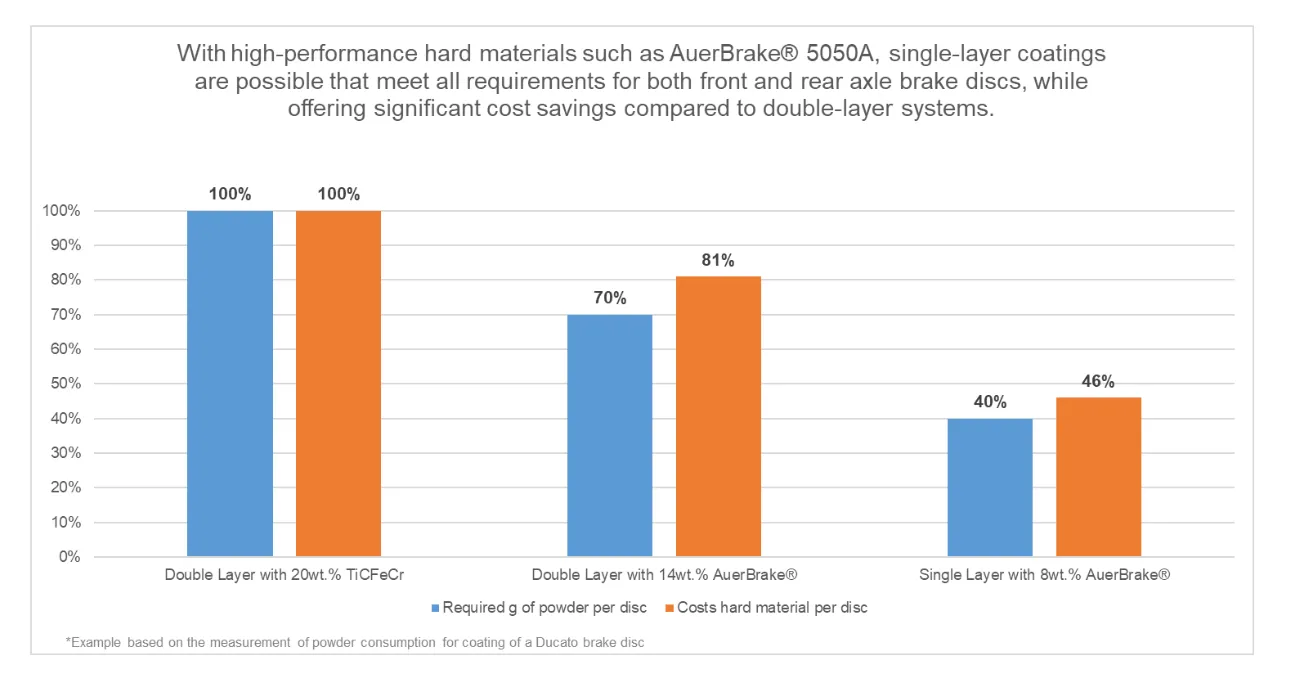
2. Coating Time: The 50% Lever
The greatest immediate cost advantage arises in High-Speed Laser Cladding. Double layer means two complete coating cycles, double laser time, double thermal exposure and double process control.
Single layer reduces pure processing time in the coating process by nearly 50%. And this refers exclusively to coating time. Not yet included are additional savings from:
- reduced equipment occupancy
- lower energy consumption
- less handling
- reduced inspection and control effort
At its core, single layer halves the coating effort.
3. Process Complexity: The Underestimated Cost Driver
Costs arise not only from material and time – but from complexity. Every additional process step increases variance, parameter dependencies, thermal exposure, the probability of error and a coordination effort. Double layer doubles these factors.
Single layer reduces the technical interfaces, process instabilities and escalation potential in series production
Less complexity means higher reproducibility, more stable series processes, lower susceptibility to disruptions and sustainable cost security. Complexity is a risk, reduction however is a strategic advantage.
Technical Credibility: Single Layer Also Convincing on the Front Axle
A central reservation is that single layer may be unsuitable for highly loaded front axles. This assessment is based on experience with conventional hard materials and steel alloys.
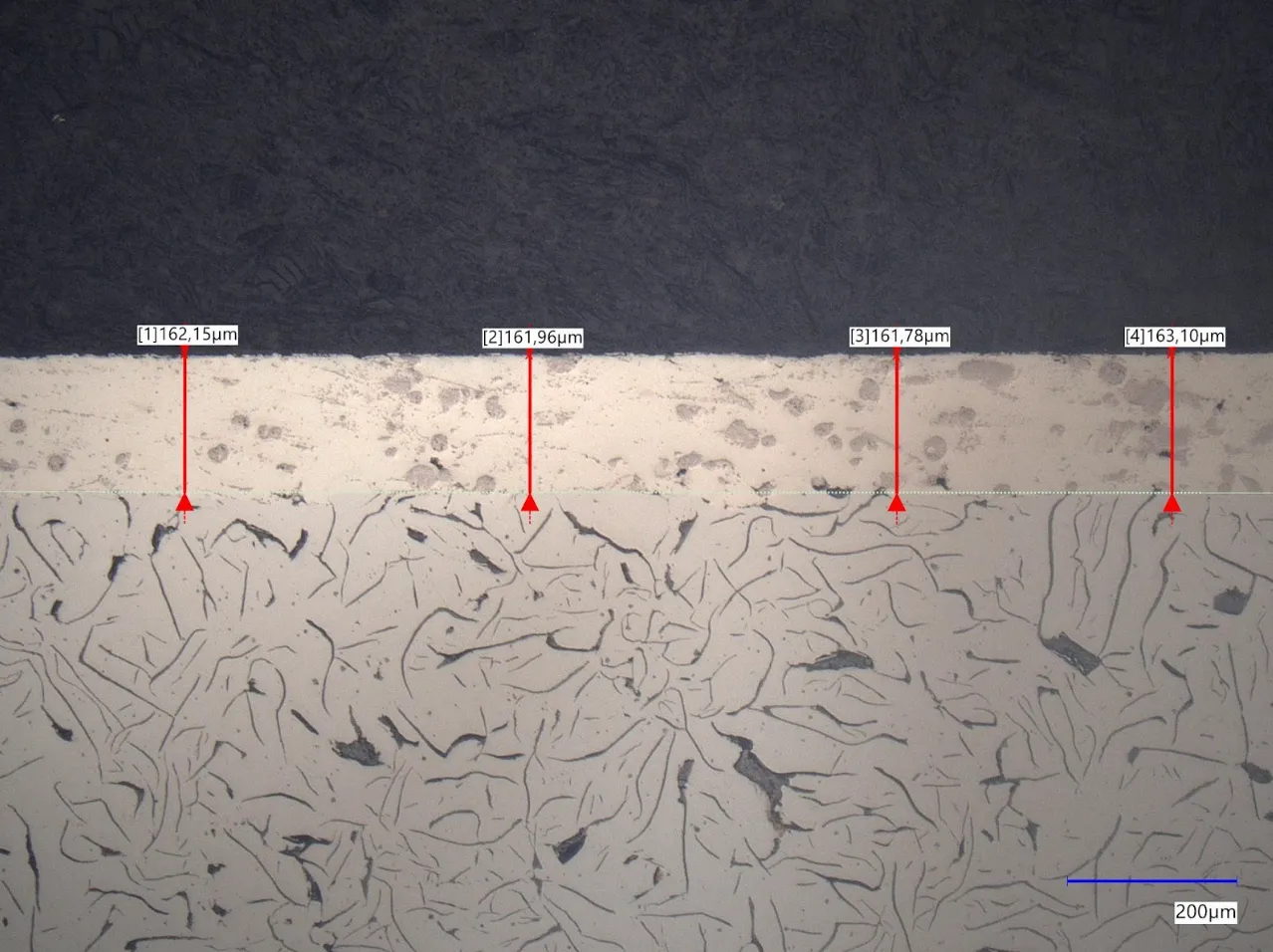
AuerBrake® in combination with steel alloys such as BD18 , 1.3820 or other alloys enables hard material contents up to 10 wt.%, coating thicknesses down to 100 µm, stable coefficients of friction and high wear protection even in front axle applications of mid-size vehicles.
These statements are technically robust and based on internal dynamometer data, testing with leading brake disc manufacturers and validations in cooperation with pad manufacturers
At the same time, it is clearly stated that double-layer systems will remain necessary in certain applications in the future – particularly in very heavy and high-performance vehicles with maximum thermal and mechanical loads. Single layer does not universally replace double layer. It optimizes however the system where it is technically appropriate and economically superior.
EURO 7: Not a Limit Value Issue – But a Risk Factor
AuerBrake®-based systems demonstrably achieve particulate emission values of 0.8–1.2 mg/km, thus the particulate limits of 7 mg/km (start of EURO 7) and 3 mg/km (foreseeable tightening) are not only met, but significantly undercut. This margin is strategically decisive.
Existing dynamometer scatter of 1–2 mg/km, external control measurements, and increasing regulatory transparency are shifting the focus from minimum compliance to reproducibility. A design “just below the limit value” therefore does not represent safety – but a calculated risk. The potential consequences are substantial and range from delayed SOP approvals, re-coating, complaints, recalls to reputational damage. Operating close to the limit creates uncertainty.
Regulatory distance creates stability. In combination with reduced process complexity, this results in a system that is economically and regulatorily robust.
Platform Capability: One Material, Multiple Performance Levels
AuerBrake® can be used for both cost-efficient single-layer systems and higher-performance double-layer systems. This creates:
- a unified material platform
- reduced development variants
- simplified sourcing
- lower inventory and process complexity
One hard material – multiple application levels.
Second Source & Security of Supply
AuerBrake® or equivalent materials are commercially available. Second sources already exist. Patents secure quality and know-how – not exclusivity. For procurement, this means security of supply, negotiation capability and scalability. Innovation in this case does not lead to dependency – but to structural optimization.
Conclusion: Targeted Optimization Instead of Conservative Oversizing
Double-layer coating systems will dominate in the short term with the start of EURO 7. In high-performance and heavy-duty vehicle applications, they will remain necessary for the time being. For standard and large segments of the premium passenger vehicle market, however, single layer based on AuerBrake® offers:
- up to 40% lower material costs
- nearly 50% reduced coating time
- significantly lower process complexity
- stable performance on the front axle
- particulate emission values of 0.8–1.2 mg/km
- long-term regulatory security
Single-layer coating systems are not a reduction, but an optimization of the overall system. It is not the maximum number of layers that creates safety – but maximum material efficiency with minimum complexity.
Treibacher Industrie AG is a globally leading company in the field of chemistry and metallurgy, headquartered in Althofen, Austria. For more than 125 years, the company – which now employs approximately 800 people – has been developing and producing high-performance materials for countless applications and industrial processes on a large scale. Treibacher’s portfolio includes a wide range of hard materials for wear protection applications in industries such as automotive, aerospace, and tooling. With its AuerBrake® material portfolio, Treibacher supports leading Tier 1 suppliers and OEMs on their path toward fulfilling the EURO 7 criteria.
Subscribe to The BRAKE Report. Get free sample chapters.