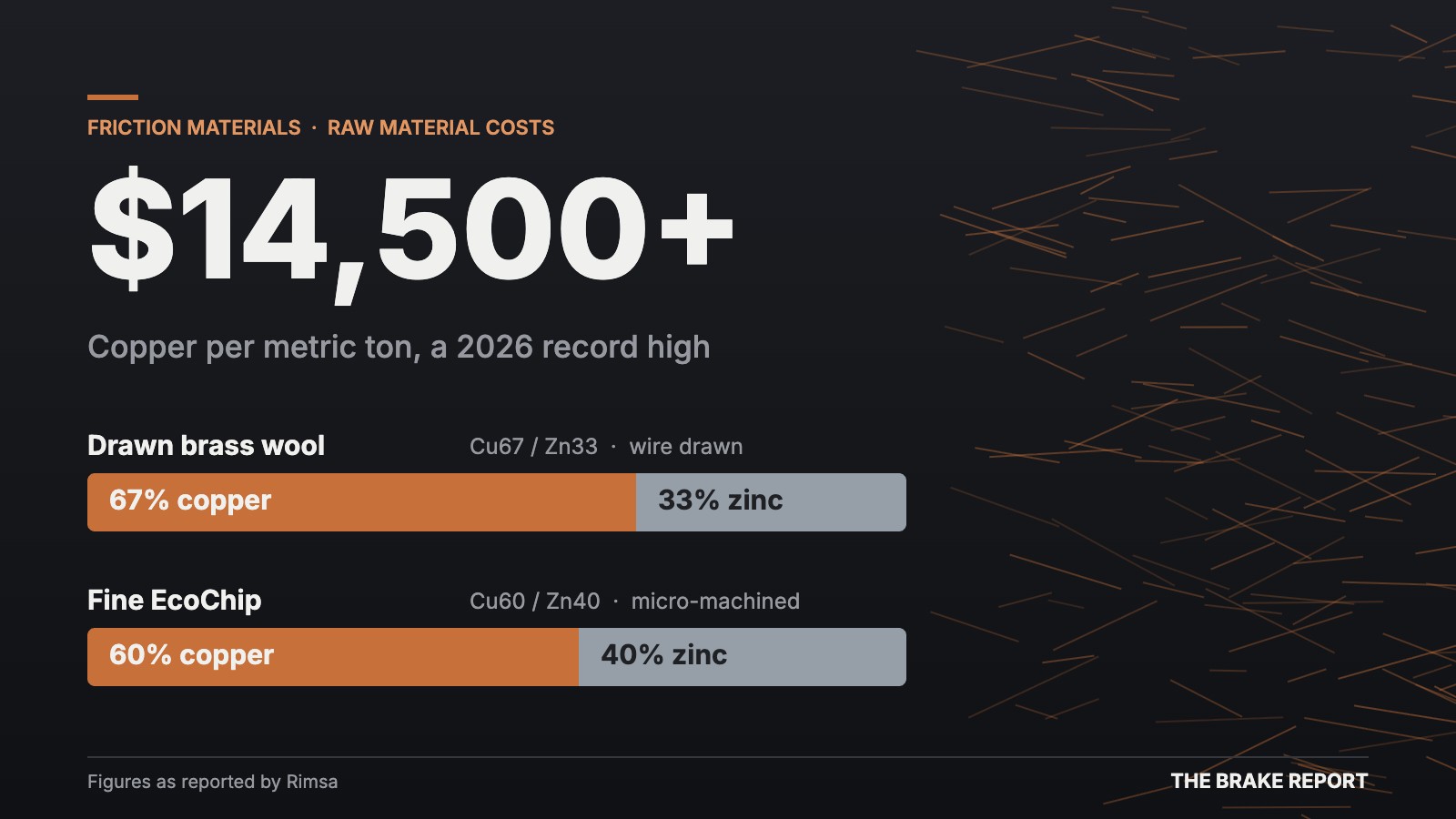

Copper prices above $14,500 per metric ton in 2026 are driving up raw-material costs for brake pad formulations that rely on brass wool, brass fiber and copper fiber, according to Spanish supplier Rimsa. In a technical article published earlier this week, the company outlines how its Fine EcoChip brass reinforcement lowers copper content and processing cost while, Rimsa says, matching the thermal performance of traditional drawn brass wool.
Why Are Copper Costs Rising?
Rimsa reports that copper prices on the London Metal Exchange (LME) and COMEX reached record highs this year. The company points to three drivers:
- Industrial demand: Spending on power grid infrastructure, renewable energy, electric vehicle manufacturing and AI data center power has expanded demand for refined copper.
- Supply constraints: Declining ore grades, water availability problems in major mining basins and scheduled smelter maintenance have limited refined output.
- Regional inventory gaps: Shifting trade flows have created physical delivery premiums in key industrial hubs.
For friction material makers, Rimsa says, the result is a higher bill of materials (BOM) for any pad that uses non-ferrous reinforcements.
What Brass Wool and Brass Fiber Do in a Pad
Rimsa, based near Barcelona, has focused on friction and reinforcement materials since 1985. The company describes copper-based reinforcements as a key ingredient in many high-performance brake pad formulations. In OE and premium aftermarket pads, it says, brass wool and brass fiber serve three functions:
- Thermal dissipation: Conducting heat away from the pad-rotor interface to prevent phenolic resin degradation and high-temperature fade.
- Structural integrity: Forming a three-dimensional metallic framework that supports shear strength and hot compression fatigue resistance.
- Friction stability and NVH: Helping form secondary plateaus, stabilizing the friction coefficient (μ) and damping low-frequency noise and vibration.
Rimsa argues that conventional brass wool and fiber carry heavy processing overhead because they are produced through multi-stage wire drawing. At current copper prices, the company says, paying that premium is an avoidable cost.
How Does Fine EcoChip Cut Costs?
Rimsa attributes the savings to two changes:
- Alloy composition: Traditional drawn brass wool typically uses 67% copper (Cu67/Zn33). Fine EcoChip uses 60% copper (Cu60/Zn40). With copper above $14,500 per ton and zinc at roughly $2,800–$3,000 per ton, replacing seven percentage points of copper with zinc lowers the raw material’s base melt value.
- Manufacturing method: Fine EcoChip is made through a proprietary dry micro-machining process rather than multi-pass wire drawing, which Rimsa describes as energy-intensive and low-yield. The process produces an acicular, or needle-like, particle with lower transformation cost per metric ton.
Rimsa does not publish a savings figure. Its cost breakdown chart is labeled illustrative.
| Parameter | Traditional Drawn Brass Wool/Fiber | Rimsa Fine EcoChip |
|---|---|---|
| Alloy | Cu67/Zn33 (67% copper) | Cu60/Zn40 (60% copper) |
| Manufacturing | Multi-stage continuous wire drawing | Controlled dry micro-machining |
| Morphology | Continuous or chopped drawn wire | Acicular (needle-like) chip |
| Thermal conductivity | ~120 W/m·K | ~120 W/m·K (per Rimsa) |
Lead-Free Compliance
Rimsa also warns that uncontrolled recycled brass scrap can introduce trace lead. According to the company, lead-contaminated shipments can fall under ADR dangerous goods classification UN 3077, adding freight surcharges, warehouse restrictions and plant-floor health, safety and environmental liability. Heavy-metal limits under REACH and OEM specifications also require batch-to-batch chemical consistency for WLTP and AK Master test repeatability.
The company says EcoChip and Fine EcoChip are certified 100% lead-free and exempt from ADR UN 3077, allowing standard non-hazardous logistics.