
The Mercedes-Benz Sprinter 2500 is the only commercial vehicle to earn a good vehicle-to-vehicle front crash prevention rating in the first crash avoidance evaluations of cargo vans and Class 3 pickups. The results come from new ratings from the Insurance Institute for Highway Safety, released this week. They show marginal and poor ratings are common across the segment. Every test still produced at least one good performer, which IIHS says shows the standard is achievable for manufacturers.
“These results are a wake-up call for commercial vehicle makers,” IIHS President David Harkey said. “Front crash prevention is especially important for these larger, heavier vans and trucks because of the danger they pose to other road users.”
Highlights
- Sprinter 2500 earns the only good vehicle-to-vehicle rating. The Chevrolet BrightDrop 400 rates acceptable, and every other model rates marginal or poor.
- BrightDrop 400 and Rivian RCV-Delivery 500 earn good ratings for pedestrian crash avoidance.
- Chevrolet Express 2500 and GMC Savana 2500 rate poor in both tests because they lack automatic emergency braking (AEB).
- 6,215 people were killed in 2024 in crashes involving heavy- or medium-duty vehicles or light vans. That is 16% of all U.S. roadway fatalities.
Why IIHS Is Rating Commercial Vehicles
IIHS launched its commercial vehicle assessment program in June with its first driver protection evaluations, which check for standard airbags, advanced seat belt technology and effective belt reminders. Many government standards for passenger vehicles do not apply to delivery vans, box trucks, tractor-trailers and larger work pickups.
The crash avoidance evaluations use the Institute’s good, acceptable, marginal and poor scale. Test protocols and rating requirements match those used for passenger vehicles. IIHS says reducing commercial vehicle deaths is a key part of its 30×30 goal of cutting U.S. roadway fatalities 30% by 2030.
The initial round covers cargo vans and Class 3 pickups. Class 3 pickups have a gross vehicle weight rating (GVWR) of 10,001 to 14,000 pounds. GVWR is the maximum safe operating weight, including passengers, cargo and the vehicle itself.
How Did Vans and Pickups Perform in the Vehicle-to-Vehicle Test?
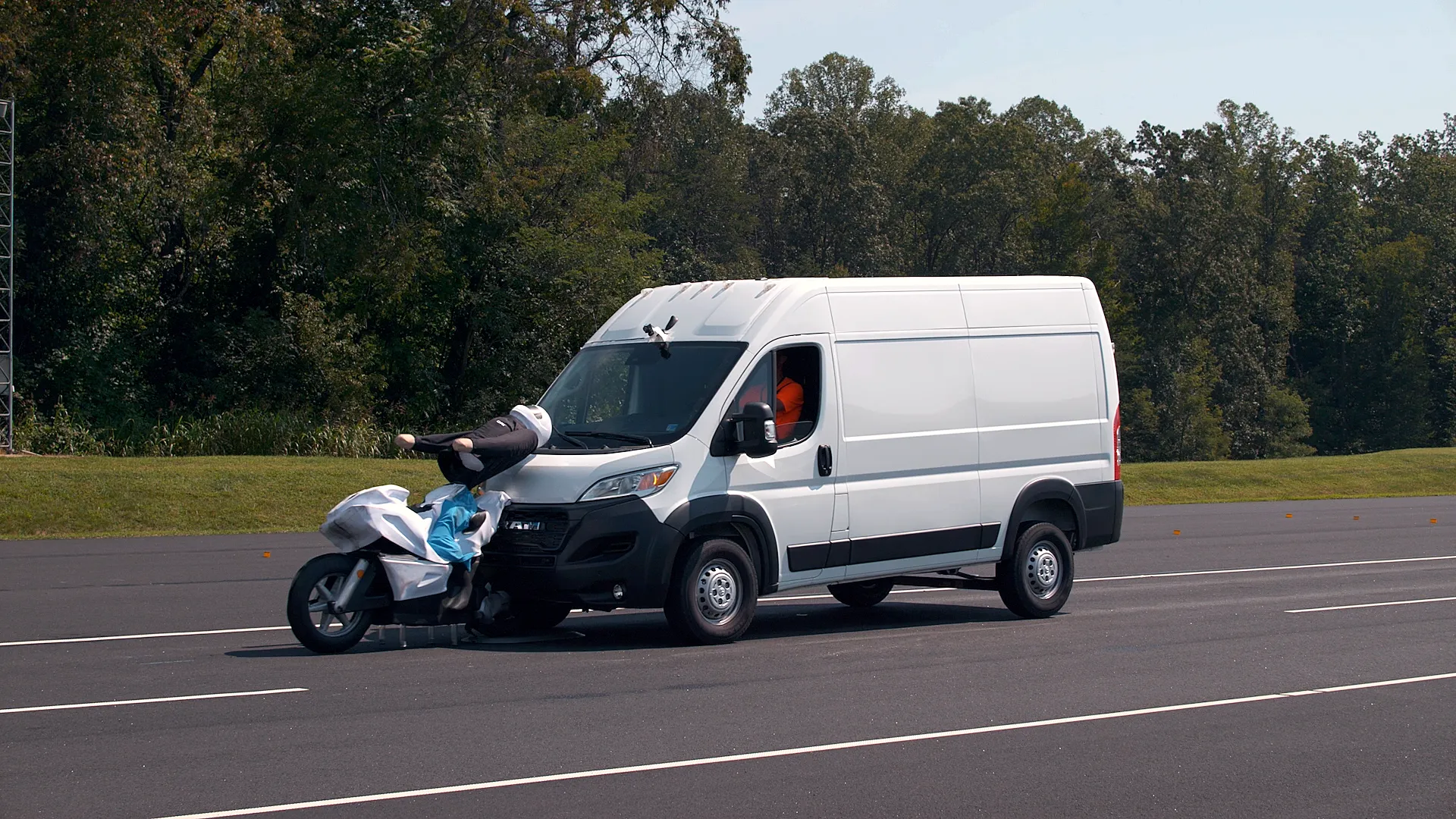
The vehicle-to-vehicle evaluation tests forward collision warning and automatic emergency braking at several speeds, using a passenger car target and a motorcycle target. It also tests forward collision warning with a semitrailer.
Results varied widely. The Express 2500 and Savana 2500 offer only an optional forward collision warning system, which produced poor ratings in both evaluations.
The motorcycle target was the hardest test:
- Several systems issued no warning and did not slow at all in most motorcycle trials.
- Other systems slowed enough to avoid or mitigate collisions at most speeds with both targets. They were downgraded because they did not warn the driver in time.
Pedestrian Crash Prevention Results
The vehicles performed better overall in the pedestrian evaluation. This test covers common daytime and nighttime crashes involving an adult or child crossing the road, or an adult walking in the travel lane.
Among cargo vans, the BrightDrop 400 and RCV-Delivery 500 rate good and the Sprinter 2500 rates acceptable. Among Class 3 pickups, the Ford F-350 and Ram 3500 rate acceptable.
Why Do Tall Trucks Miss the Child Target?
Several vehicles, including the F-350 and Ram 3500, had more trouble detecting and avoiding the child dummy in daylight than avoiding the adult at night. IIHS says the cause may be the child dummy’s shorter height combined with the vehicles’ tall front ends and detection sensors mounted near the rearview mirror. In some trials, the system detected the child at a distance but lost it as the vehicle got closer.
Poor and marginal systems also failed to slow enough in most nighttime trials with the adult target. Some vehicles performed much worse on low beams than on high beams. Others did worse at the slowest test speed than at faster ones.
Front Crash Prevention Ratings
| Model | Type | Vehicle-to-vehicle | Pedestrian |
|---|---|---|---|
| 2025-26 Chevrolet BrightDrop 400 | Cargo van | Acceptable | Good |
| 2025-27 Chevrolet Express 2500 | Cargo van | Poor | Poor |
| 2025 Ford Transit T250 | Cargo van | Poor | Marginal |
| 2025-27 GMC Savana 2500 | Cargo van | Poor | Poor |
| 2025 Mercedes-Benz Sprinter 2500 | Cargo van | Good | Acceptable |
| 2025-27 Ram ProMaster 2500 | Cargo van | Poor | Marginal |
| 2025 Rivian RCV-Delivery 500 | Cargo van | Marginal | Good |
| 2025-26 Chevrolet Silverado 3500HD | Class 3 pickup | Poor | Marginal |
| 2025 Ford F-350 | Class 3 pickup | Poor | Acceptable |
| 2025-26 GMC Sierra 3500 | Class 3 pickup | Poor | Marginal |
| 2025-27 Ram 3500 | Class 3 pickup | Marginal | Acceptable |
What Comes Next
IIHS will keep evaluating Class 3 vehicles through this year and next, adding ratings for headlights and rear AEB. Testing of larger Class 4-6 trucks will be phased in later. Full results are on the IIHS commercial vehicles ratings page.