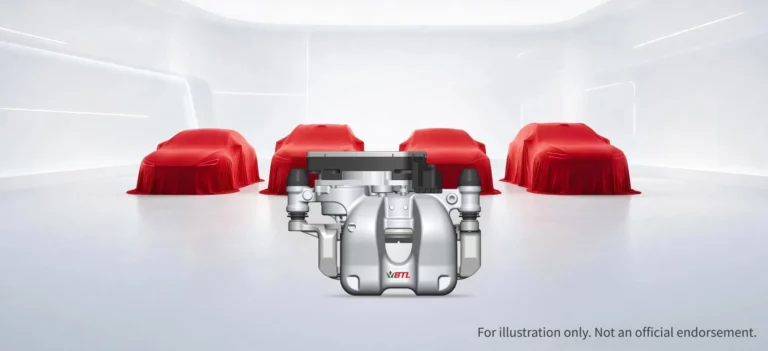
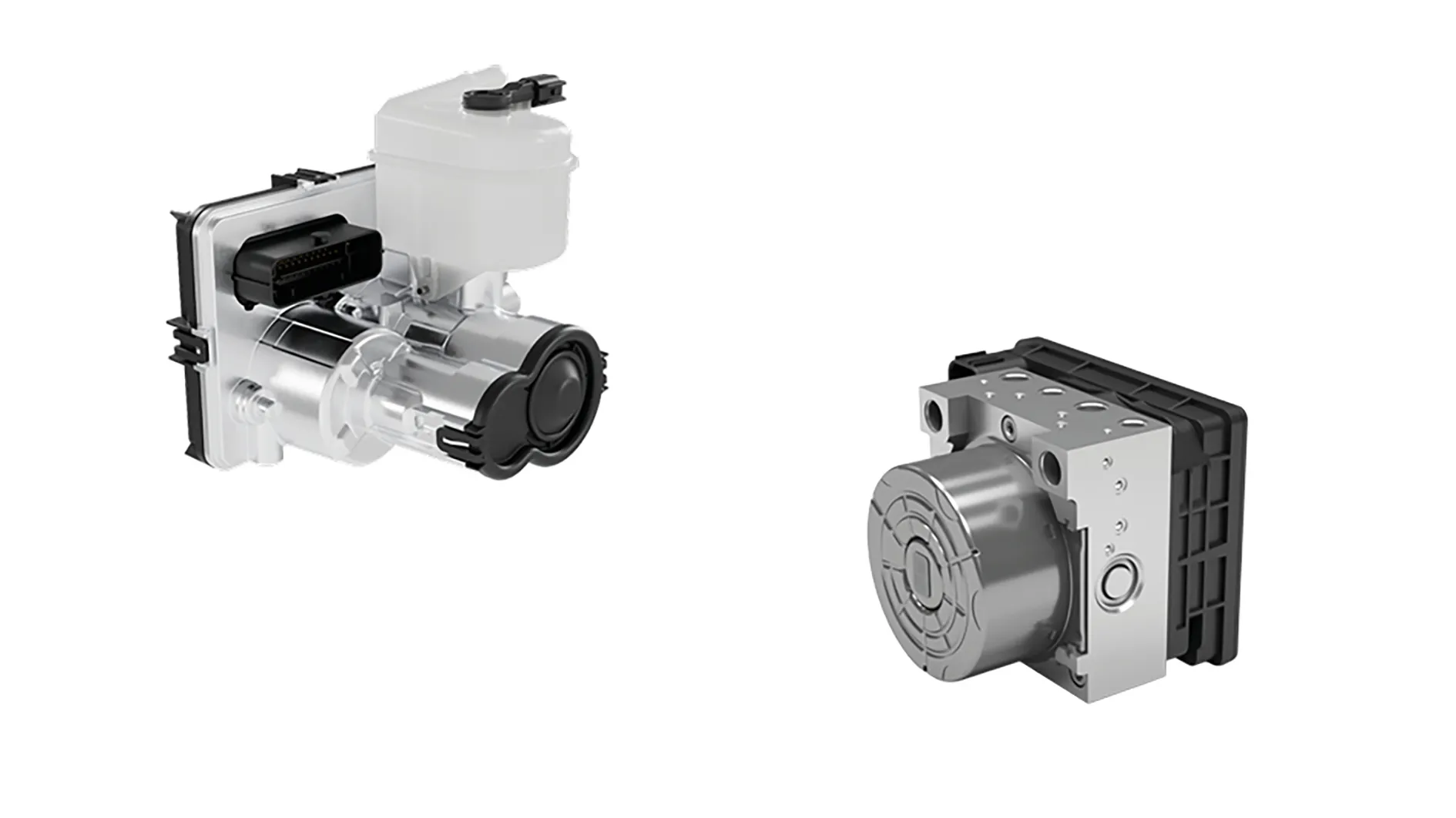

AUMOVIO has unveiled its distributed brake system, a true brake-by-wire evolution of its electrohydraulic one-box brakes, and has already booked a first series order from a major Chinese automaker with production scheduled to begin at the end of 2027. The Frankfurt-based supplier says the distributed brake system pairs an advanced one-box brake with an Electronic Stability Control (ESC) unit and operates fully electronically from the pedal through to the fallback level. According to the company, the layout allows smaller, lighter actuators that free up installation space and deliver more braking performance than its previous one-box generation.
Highlights
- Two actuators, both active: unlike current one-box systems for highly automated driving, where a second actuator sits idle as a fallback, both actuators in the distributed brake generate braking force together, the company says
- Four-wheel fallback: AUMOVIO reports the system continues to brake all four wheels in fallback mode, where most competing systems act on only two or three
- First series order: a major Chinese vehicle manufacturer has placed the first order, with production start scheduled for the end of 2027
- Heritage volume: the system builds on the MK C1 and MK C2 one-box pressure providers, of which more than 15 million have been sold since their 2016 market launch
How Does the Distributed Brake System Differ From a One-Box Brake?
Current one-box brake systems for highly automated driving (HAD) contain two brake actuators, but only one operates during normal driving. The second serves purely as a fallback. The distributed brake system instead keeps both actuators permanently active so they can build braking force together when required, while each remains designed to function independently if the other fails.
AUMOVIO says this arrangement lets the actuators be made smaller, lighter, and more energy-efficient than prior one-box units. By coordinating the two actuators, the company reports higher braking performance than predecessor models in both normal driving and emergency mode.
The fallback behavior is a key claim. According to the release, most other braking systems act on only two or three wheels in fallback mode, whereas the distributed brake system continues to access all four wheels. AUMOVIO positions this as particularly relevant for highly automated driving, where safety during an electrical failure is critical, and says the architecture supports automated driving up to SAE Level 5.
“The mobility of the future is automated, electric, and increasingly based on new vehicle architectures. This transformation will not happen overnight, but step by step. With our solutions ranging from electrohydraulic to fully dry braking systems, our customers can draw on a very broad product portfolio. The new distributed brake system expands this portfolio even further. It gives our customers even greater flexibility, efficiency, and powerful performance. With its first series order, our new system is taking an important step toward high-volume production,” said Boris Mergell, Head of the Safety and Motion business area at AUMOVIO.
Modern E/E Architectures Enable Placement Flexibility
The distributed brake system depends on the electrical/electronic (E/E) architecture of modern vehicles, which includes multiple power supply points and redundant electrical networks. AUMOVIO says that architecture satisfies the requirements for a braking system without a hydraulic fallback, which must carry a redundant system with its own electrical circuit.
Because the driver’s braking commands travel electrically and no mechanical-hydraulic connection to the driver is needed, almost all braking components except the electronic brake pedal can be positioned freely in the front section of the vehicle. The company says this supports new vehicle concepts and optimized use of installation space, for example by fitting a larger high-voltage battery to extend range.
AUMOVIO adds that the system is not limited to EVs. Fully electric and hybrid vehicles use redundant E/E architectures, but the company notes that many new combustion-engine vehicles now do as well, broadening the addressable market.
Efficient E-Pedal Concept Through Brake-by-Wire
Removing the mechanical-hydraulic pedal connection yields two further benefits, according to the release:
- Reduced residual drag: the air gap between brake disc and caliper can be increased because fallback brake pressure is built up electronically with greater precision and speed than before, reducing unwanted friction between disc and caliper
- Variant reduction: a single e-pedal braking system can serve a wide range of vehicle architectures, eliminating separate variants for left- and right-hand drive or for combustion and electric powertrains, which AUMOVIO says lowers development, manufacturing, and logistics costs for suppliers and automakers alike
Where the Distributed Brake Fits in AUMOVIO’s Roadmap
AUMOVIO cites 120 years of vehicle-safety experience behind the new system. Its most recent major braking milestone was the electrohydraulic pressure provider used in the MK C1 and MK C2 one-box systems, with more than 15 million units sold since the 2016 market launch. The company says that expertise has been carried into a true brake-by-wire application that combines hydraulic braking strengths with an electromechanical brake architecture, and the distributed brake sits within its published brake system roadmap alongside electrohydraulic and fully dry systems.
The announcement lands as by-wire braking moves from roadmap to production across the supply base. Brembo said in May that its Sensify brake-by-wire platform entered series production with a global automaker, and AUMOVIO itself has been reshaping its European footprint this year, including the planned sale of its Mechelen MK-series brake systems plant to Dumarey Group.