

Originally reported by David Kidd at the Insurance Institute for Highway Safety (March 12, 2026). Read the full story →
The Insurance Institute for Highway Safety is bringing its influential commercial vehicle safety ratings program to cargo vans and heavy-duty pickups for the first time. The move addresses a long-standing blind spot in the U.S. safety framework: the millions of work vehicles that operate daily without the same crash protection standards applied to passenger cars. With more than 6,500 fatalities linked to commercial vehicle crashes in 2023 alone, the initiative targets a segment where basic features like airbags and automatic emergency braking remain optional rather than required. For brake and safety technology suppliers, the expansion signals a coming wave of demand from fleet operators seeking to meet new benchmarks.
A Regulatory Gap With Real Consequences
Commercial vehicles have long occupied an uncomfortable space in the U.S. safety system. Many federal crashworthiness and crash avoidance mandates that apply to passenger cars simply do not extend to work trucks and vans. As a result, vehicles in the 10,001-to-14,000-pound gross vehicle weight range frequently ship without airbags, advanced seatbelt systems, or automatic emergency braking. This matters enormously in real-world outcomes. According to IIHS data, crashes involving medium- and heavy-duty trucks or light vans accounted for roughly 16 percent of all U.S. roadway fatalities in 2023. Moreover, the majority of those killed in truck-involved crashes are occupants of other vehicles — underscoring the need for both occupant protection and crash avoidance technology on the commercial side.
The timing aligns with IIHS’s broader strategic goal of cutting U.S. traffic deaths by 30 percent before the end of the decade. Commercial vehicle safety now ranks as one of three core pillars in that plan, alongside reducing risky driving behavior and expanding safety access across all road users.
What the New Ratings Will Cover
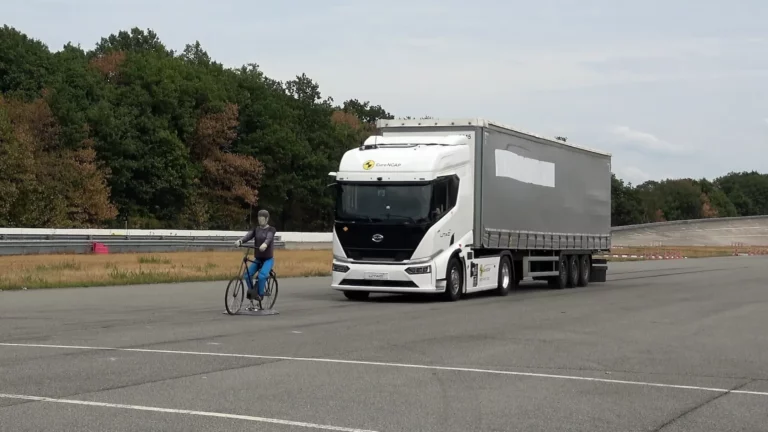
IIHS plans to release occupant protection ratings for cargo vans and Class 3 pickups this spring. These initial evaluations will assess whether vehicles come equipped with fundamental safety hardware — including airbags and advanced restraint systems — that the aftermarket and OEM sectors have long standardized in passenger vehicles. Concurrently, the institute is conducting track-based crash avoidance testing. Results from those evaluations will follow later in the year.
For brake system and safety component manufacturers, this phased rollout is significant. It effectively creates a new product pull from fleet purchasers who will face pressure to select vehicles meeting IIHS benchmarks. The organization has signaled that evaluations will eventually expand to box trucks and potentially tractor-trailers, broadening the addressable market for suppliers of AEB modules, sensor arrays, and advanced braking hardware.
Underride Protection Gets an Upgrade
IIHS is also building on its existing work in commercial vehicle safety. The institute has tested rear underride guards on semi-trailers since 2010. Its Toughguard recognition program, launched in 2017, initially certified equipment from just one manufacturer. Today, nearly every new dry van trailer on the market qualifies — a clear example of how independent ratings can reshape supplier behavior and industry standards.
The next frontier is side underride protection. Few trailers currently feature side guards, but IIHS estimates that wider adoption could prevent more than 300 fatalities annually. Updated award criteria are expected in coming years, which could drive significant new demand for guard systems and associated structural components across the trailer manufacturing supply chain.
Fleet Operators as Safety Accelerators
One of the most consequential dynamics in this story is the role of fleet purchasing decisions. Unlike individual consumers choosing a family sedan, a single fleet operator can influence the safety equipment on hundreds or thousands of vehicles with one procurement policy change. IIHS is positioning its ratings to give fleet managers a clear, independent benchmark for making those decisions.
Additionally, fleets are emerging as early adopters of technologies not yet common in consumer vehicles. Intelligent speed assistance is one example gaining traction among fleet operators. IIHS recently published research outlining best practices for ISA deployment, adding another tool to the fleet safety toolkit. Meanwhile, the institute’s sister organization, HLDI, has begun aggregating insurance loss data for commercial vehicles — the same type of analysis that proved instrumental in validating crash avoidance technology effectiveness on the passenger side.
Bottom Line
IIHS’s expansion into commercial vehicle ratings fills a critical gap where federal standards have lagged. For brake and safety technology suppliers, this creates a new market dynamic: fleet operators will increasingly demand vehicles equipped with AEB, advanced restraints, and improved underride protection. The companies positioned to supply those systems stand to benefit as independent safety benchmarks reshape commercial vehicle purchasing decisions over the next several years.
Subscribe to The BRAKE Report. Get free sample chapters.