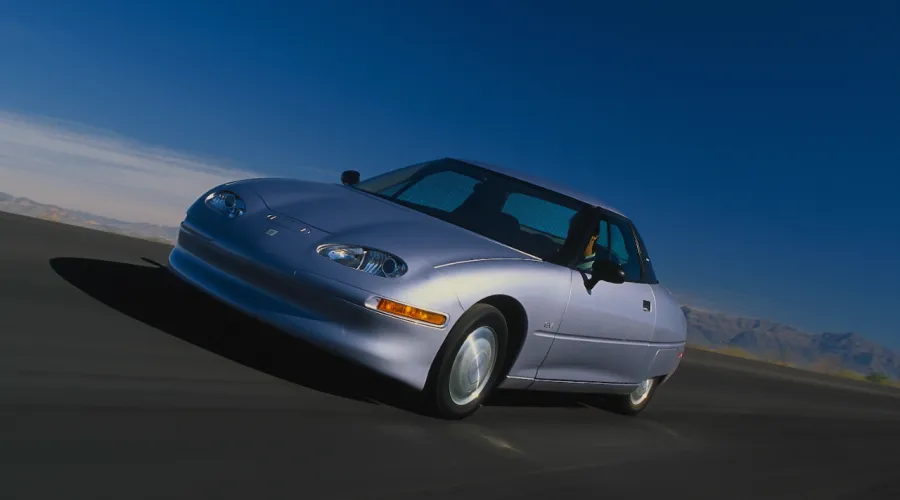

General Motors has credited its current brake blending strategy to control work done on the EV1 and the Precept concept that followed it, with the 1999 model-year EV1 using regenerative braking for roughly 90% of low-speed deceleration — worth about 10 miles on a car that offered around 90 miles of range. The account comes from Brandon Vivian, today Executive Chief Engineer for GM Defense and Cadillac V-Series, who joined the EV1 program in 1995 as his first assignment at the automaker and later owned braking system improvements for the 1999 car. His recollection places two distinct blending philosophies — friction-first and regen-first — at the origin of an architecture GM says still governs how its vehicles stop.
Highlights
- Regenerative braking handled approximately 90% of low-speed deceleration on the 1999 model-year EV1, adding roughly 10 miles to a range of about 90 miles
- The EV1 blended friction and regenerative braking through the Brake Torque Control Module (BTCM), with a fully mechanical backup linkage retained for safety
- The EV1 ran a friction-first strategy; the 2000 Precept diesel-electric hybrid switched to regen-first, the strategy GM says its vehicles use today
- GM’s eBoost brake-by-wire system carries the architecture into internal-combustion vehicles, varying pedal feel by drive mode in Cadillac V-Series models and the Corvette
What Made the EV1 Braking System Different?
Conventional hydraulic braking converts kinetic energy into heat through pad-on-rotor friction, and that heat dissipates into the atmosphere unrecovered. An electric motor offers a second path: acting as a generator, it resists the vehicle’s momentum and returns energy to the battery during deceleration. The EV1 team pursued that energy recovery specifically to extend range from mid-1990s battery technology, alongside a lightweight structure and low-drag bodywork.
The engineering problem was combining both mechanisms under a single conventional brake pedal. The team’s answer was brake-by-wire — the pedal actuates an electronic system that commands regenerative and friction braking together rather than connecting directly to the hydraulics. Pressing the pedal generates an electrical signal to a computer, which interprets the requested braking force and determines how to deliver it. In the EV1, that computer was the Brake Torque Control Module, translating pedal input into a friction-and-regen mix. The pedal also retained a fully mechanical backup connection.
GM at the time called the system “the world’s most efficient and intelligent stopping system ever fitted to a production automobile,” a claim the company made for the vehicle in period marketing. The brake-by-wire arrangement was unusual for a production car of that era.
Friction-First Versus Regen-First
The distinction that matters for control engineers is sequencing. “On the EV1, we had a friction-first strategy,” Vivian says. Pedal application engaged the friction brakes immediately, with regenerative braking blended in afterward according to how much deceleration the driver requested and how much charge the battery could accept.
Vivian’s next assignment, the GM Precept concept — a diesel-electric hybrid that carried over much of the EV1’s technology, including its braking system — inverted that order. The Precept actuated regenerative braking first on pedal application, then added friction braking as required. Vivian says that basic control strategy remains in use across GM vehicles today.
“We were able to apply the lessons we learned with the EV1 and the Precept as brake systems got more and more sophisticated,” Vivian says.
How the Architecture Reaches Current Production
GM’s current EVs operate on the same conceptual basis: the driver presses the pedal, onboard computers apportion friction and regenerative braking, and a mechanical backup stands behind the electronic system as it did on the EV1. Those vehicles additionally allow drivers to trigger regenerative braking by lifting off the accelerator, at selectable levels of force. One-Pedal Driving permits regenerative braking alone to bring the vehicle to a full stop in many scenarios, and Regen on Demand adds further regenerative force for situations such as long descents. GM notes both features can be limited by extreme battery temperature or a near-full state of charge.
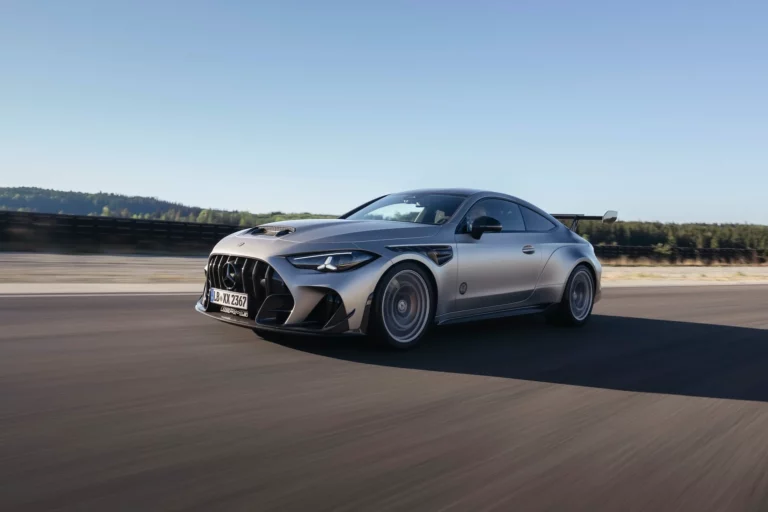
The transfer has not been confined to electric vehicles. GM’s current brake-by-wire system, eBoost, enables fine tuning of pedal feel under the driver’s foot. In Cadillac V-Series models and the Corvette, pedal feel changes with the selected drive mode, giving track-oriented response where the driver calls for it. eBoost also improves implementation of driver-assistance functions including Super Cruise, automatic emergency braking, and pedestrian braking.
For friction suppliers, the through-line is a control layer that decides when their product is called on at all — and a sequencing choice made on a concept car in 2000 that still sets that boundary.
“What started as a small project has come full circle and is being applied ubiquitously across the fleet,” Vivian says. “That’s why you do these things, right? You have to develop the technology and the ecosystem around it.”
GM is revisiting the EV1’s legacy in connection with a restoration by the YouTube channel The Questionable Garage.
“The definition of innovation is when you take technology and make someone’s life simpler or provide real value,” Vivian says. “Technology is just technology. Until it has value, it doesn’t become innovation.”
Subscribe to The BRAKE Report. Get free sample chapters.