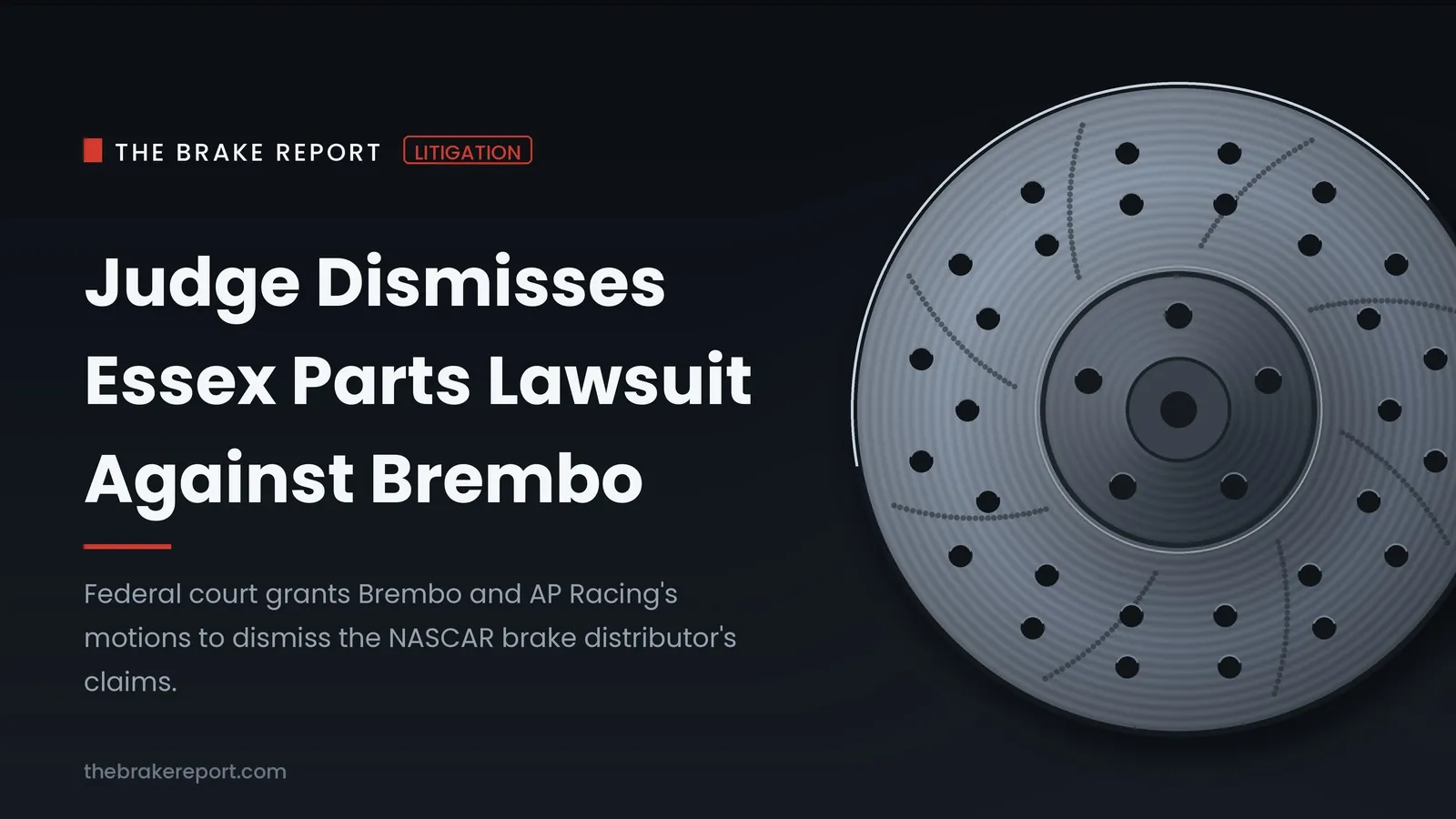

A federal judge has dismissed Essex Parts Services’ lawsuit against Brembo NV and its AP Racing subsidiary, granting both companies’ motions to dismiss and ending the NASCAR brake distributor’s claims that Brembo improperly pressured it to absorb roughly $970,000 in debt owed by a separate, bankrupt company. U.S. District Judge Kenneth D. Bell, in a memorandum and order entered this week in the Western District of North Carolina, found that Essex failed to plausibly allege the two claims at the center of its case: tortious interference with a prospective contract and a violation of the state’s unfair and deceptive trade practices act. The order directs the court clerk to close the matter.
Highlights
- Judge Kenneth D. Bell granted motions to dismiss filed by both Brembo NV and AP Racing, dismissing every Essex Parts Services claim and directing the clerk to close the case.
- The court found Essex did not plausibly allege tortious interference, which under North Carolina law required a complaint that “admit[s] of no motive for interference other than malice” — a bar Essex’s own pleadings undercut.
- The related unfair-trade-practices claim was dismissed because it rested on the same facts as the failed interference claim.
- The dispute traced to nearly $970,000 that a separate company, TAW Performance, owed Brembo under a consent judgment, plus a $350,000 settlement figure and a proposed $250,000-per-year purchase increase.
What the Court Decided
The court first rejected Brembo’s argument that it lacked sufficient ties to North Carolina, holding that Brembo had directed enough purposeful conduct at the state — through emails to Essex’s ownership and its role in the contract negotiations — to support specific personal jurisdiction. The dismissal therefore turned on the substance of Essex’s pleadings, not on jurisdiction.
On the central claim, the court treated Brembo as a “non-outsider” to the AP Racing–Essex relationship: as AP’s parent, Brembo had a legitimate business interest in its subsidiary’s contracts, so its conduct was presumed justified. To overcome that presumption, Essex had to show its complaint admitted no motive other than malice. It could not. The court pointed to Essex’s own allegation that the defendants were weighing whether to “take the business for themselves,” which suggested a legitimate commercial motive and undercut any claim of purely malicious intent. The court added that Essex cited no authority making it unlawful for a parent company to consider its past disputes with a business owner when deciding whom to do business with.
Because the unfair-trade-practices claim rested on the same facts, it failed alongside the interference claim and was dismissed as to both Brembo and AP Racing.
Background: The TAW Debt and the AP Racing Deal
Essex and AP Racing have done business since 1987, and AP became the exclusive brake supplier to all NASCAR Cup Series teams in 2020; a 2022 set of agreements designated Essex the exclusive U.S. reseller of AP products. Brembo has owned AP Racing since 1999.
The conflict originated with a different company. According to Essex’s complaint, a 2014 agreement made TAW Performance — like Essex, majority-owned by Richard Martin — the exclusive U.S. distributor of Brembo motorcycle brakes. After gray-market product eroded that business, Brembo terminated the deal in 2017 and pursued litigation claiming TAW owed more than $1 million. TAW filed for Chapter 7 bankruptcy in 2024 and, in early 2025, agreed to a consent judgment of nearly $970,000.
As Essex renegotiated its AP Racing contract in late 2025, Brembo’s performance-unit chief emailed Martin raising a $350,000 settlement of the TAW matter. Essex characterized the message as a demand; the court, reviewing the email itself, described it as a settlement overture stating that $350,000 “would be a compromise” toward resolving the parties’ disputes. Brembo later sought to raise Essex’s annual purchase commitments by $250,000 a year over a proposed five-year term. After AP declined to countersign the renewal Martin had signed, Essex sued — the allegations laid out in its original federal complaint. Brembo had called the claims “groundless” from the outset.
What to Know
What claims did Essex bring, and what happened to them?
Essex asserted that Brembo tortiously interfered with its prospective renewed contract with AP Racing and that both companies violated North Carolina’s Unfair and Deceptive Trade Practices Act. The court dismissed every claim against both defendants on the pleadings, granting their motions to dismiss in full.
Why did the court side with Brembo and AP Racing?
As AP’s parent, Brembo was treated as a “non-outsider” with a legitimate interest in its subsidiary’s contracts, so its conduct was presumed justified. Essex’s own complaint acknowledged the defendants might “take the business for themselves,” which the court said undercut any showing of a purely malicious motive.
Did the court find Brembo had no connection to North Carolina?
No. The court rejected Brembo’s jurisdiction argument and held it could exercise specific personal jurisdiction, citing emails to Essex’s owner and Brembo’s involvement in the contract negotiations. The dismissal rested on the weakness of Essex’s claims, not on any lack of jurisdiction.
Subscribe to The BRAKE Report. Get free sample chapters.