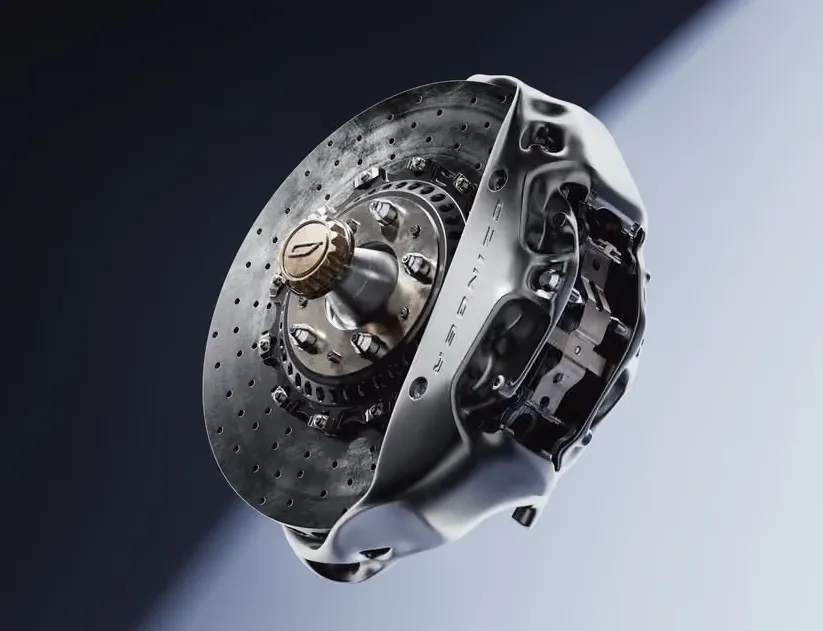

Czinger Vehicles has introduced BrakeNode, an additively manufactured assembly that consolidates the brake caliper, suspension upright, and hydraulic fluid passages into a single part the company says cuts stopping distance by as much as 15 percent. The component debuts as standard equipment on the 21C Spyder, a $2.75 million open-top hypercar limited to 30 hand-assembled units, and is offered as a retrofit for existing 21C HDF and VMax owners. Czinger describes BrakeNode as the first production system to combine those three functions in one topology-optimized structure.
Highlights
- BrakeNode combines caliper, upright, and hydraulic fluid passages into one additively manufactured part
- Czinger reports a 30 percent gain over a conventional brake structure in both unsprung mass reduction and stiffness, and 1.5 pounds saved at each wheel
- Hollow load-bearing sections account for as much as 37 percent of the part’s material
- The assembly was pressure-tested to 500 bar, roughly eight times normal operating pressure

One Part Replaces the Caliper, Upright, and Brake Lines
Conventional corner assemblies bolt a caliper to a separate suspension upright and route brake fluid through external high-pressure lines. BrakeNode eliminates both interfaces: the caliper body and upright are printed as one structure, and the fluid runs through internal channels, removing the exposed lines found on a typical setup. Czinger reports the design saves 1.5 pounds of unsprung mass at each wheel and delivers a 30 percent improvement in both unsprung mass and stiffness relative to a conventional brake structure.
Hollow, load-bearing sections make up as much as 37 percent of the part’s material. A mechanical disc bell connects the rotor to the hub.
What Materials Does BrakeNode Use?
The structure is printed from Z301, an aluminum alloy Czinger developed in-house. The company says it pressure-tested the assembly to 500 bar — about eight times what the brake system encounters in normal driving.
Piston material differs front to rear. Front calipers use titanium pistons carried over from Formula 1 applications, which Czinger says hold brake fluid roughly 15 percent cooler than stainless-steel pistons would. Rear calipers use aluminum pistons to save weight instead.
| Specification | Front | Rear |
|---|---|---|
| Rotor diameter | 410 mm (16.1 inches) | 390 mm (15.3 inches) |
| Rotor material | Carbon-ceramic | Carbon-ceramic |
| Piston material | Titanium | Aluminum |
Serviceability Without Caliper Removal
Czinger says the integrated design is easier to service than a conventional assembly because the caliper never has to be disconnected to reach the friction components. Pads are replaced by reaching through the top of the structure, and rotors tilt out from the side. A drain plug at the bottom of the part handles hydraulic fluid removal.
Additive Manufacturing Across the Vehicle
BrakeNode sits within a broader additive strategy: Czinger says 23 percent of the 21C Spyder is produced using additive processes developed with Divergent Technologies. A second consolidated part, MegaNode, folds the steering rack, electric motor housings, front suspension components, and front crash structure into a single piece, saving 25 percent of the weight those components carried when built individually. The company also prints the suspension control arms and steering rack housing, and says the topology-optimized gearbox casing is the first of its kind fitted to a production car.
“We started Czinger to build the next era of automotive performance. Not a faster version of cars that have come before, but something fundamentally new,” said Lukas Czinger, Founder and Chief Executive Officer of Czinger Vehicles. “A hypercar designed from the ground up and built using technology the automotive world had never seen. That car is the 21C, and with 21C Spyder, we’re going even further, amplifying the driver’s connection to the car, debuting world-first technology, and introducing an all-new cockpit experience. The 21C Spyder delivers a drive with no equal.”
Production and Availability
The 21C Spyder is limited to 30 units, hand-assembled at Czinger’s Area 21 facility in Los Angeles, with pricing from $2.75 million. BrakeNode is standard on the Spyder and available as a retrofit for previously delivered 21C HDF and VMax cars.
Subscribe to The BRAKE Report. Get free sample chapters.