
What does a senior friction materials engineer earn in 2026? If that role were in powertrain or semiconductor packaging, the answer would be easy to find. Multiple benchmarking tools and salary surveys exist for those fields. But for brake professionals — friction engineers, NVH specialists, brake-by-wire architects, copper-free compound formulators — reliable compensation data has never existed.
General automotive surveys lump brake engineers in with every other component discipline. Manufacturing salary data draws no distinction between a plant running friction material mixing lines and one stamping body panels. The result is an industry that has made pay decisions on gut instinct, internal precedent, and trade show hallway conversations for decades.
That worked when the market was predictable. It is becoming a serious liability now that the market is anything but.
Highlights
- Mid-level professionals with both brake domain knowledge and software or controls skills are now harder to recruit than senior executives.
- Friction material formulators rank among the most difficult-to-replace specialists in the entire supply chain, with almost no academic pipeline feeding the discipline.
- Brake-by-wire systems engineers carry a “critical” scarcity rating, with typical searches stretching four to eight months.
- Companies with hiring timelines exceeding three months are consistently losing top candidates to faster competitors.
Three Forces Colliding at Once
The brake industry’s compensation landscape is being reshaped by pressures that arrived nearly simultaneously.
The Software Invasion
Electrification has fundamentally changed who brake companies need to hire. Software engineers, controls specialists, and systems architects are now essential in organizations that spent decades recruiting almost exclusively from mechanical engineering programs. These professionals command higher compensation — and they have no shortage of options outside the brake sector entirely.
The Knowledge Cliff
A generation of brake veterans who built their careers during the industry’s rapid globalization in the 1990s and 2000s is heading for the exits. Their deep institutional knowledge of formulation chemistry, NVH tuning, and manufacturing process optimization was accumulated over decades. It cannot be downloaded into a successor over a two-week transition period, and it is not being replenished at anywhere near the same rate.
The Geography Problem
Brake manufacturing facilities and desirable talent markets often occupy different zip codes. Hybrid work arrangements have softened this tension for some engineering and commercial roles, but the mismatch remains a persistent recruiting obstacle for plant-level and hands-on technical positions.
Companies still anchoring job postings to 2022 or 2023 pay benchmarks are watching time-to-fill stretch longer and candidate quality decline. The market moved. Many salary structures did not.
Inside the Industry’s First Dedicated Compensation Study
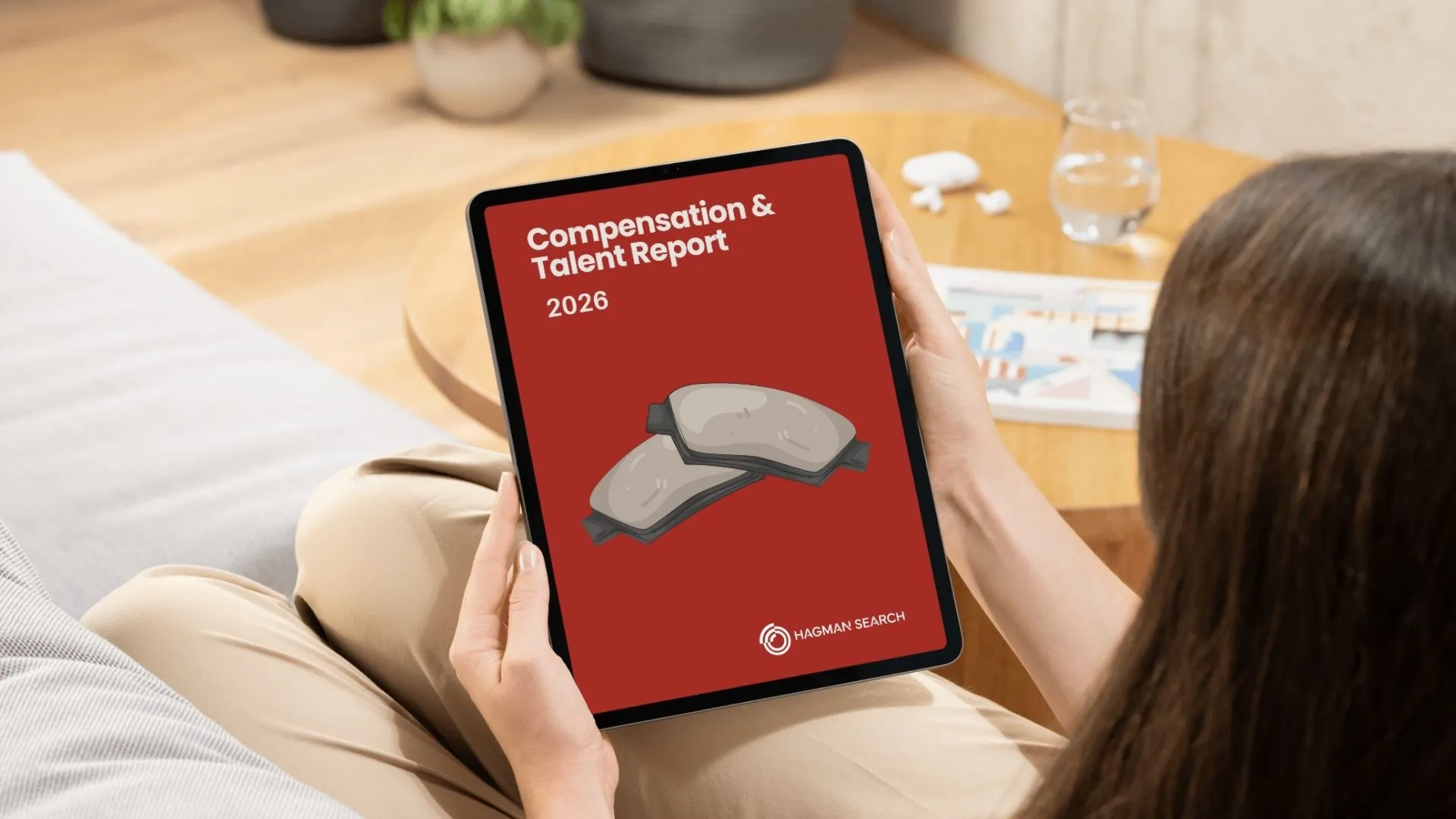
Hagman Search, the retained executive recruiting firm focused exclusively on the brake industry, has published what it calls the first-ever Brake Industry Compensation & Talent Report.
The 2026 Edition spans six functional areas:
- Engineering
- Manufacturing and operations
- Quality
- Sales
- R&D
- Executive leadership
Beyond base salary ranges, the report covers regional compensation dynamics, total compensation and benefits trends, and a proprietary talent scarcity index that rates how difficult specific brake roles are to fill in the current market.
Built From Real Negotiations, Not Job Postings
The methodology sets this report apart from conventional salary surveys. Rather than relying on statistical sampling or self-reported data, Hagman Search drew on pattern-based insights from more than a decade of recruiting engagements. That dataset includes hundreds of candidate conversations, completed offer negotiations, and hiring manager consultations conducted across the brake supply chain.
Brian Hagman, founder of Hagman Search, said the firm’s data reflects what companies actually pay once negotiations conclude — not what appears on a job listing. He noted that certain roles remain open for months because budgets fail to reflect market reality, while positions with competitive offers attract strong candidates within weeks.
The report is upfront about its limits. It positions itself as directional intelligence rather than a controlled statistical survey and recommends that companies use it as one input alongside their own internal data.
Free Download Available
The full Brake Industry Compensation & Talent Report: 2026 Edition is available as a free download at www.hagmansearch.com.
Subscribe to The BRAKE Report. Get free sample chapters.