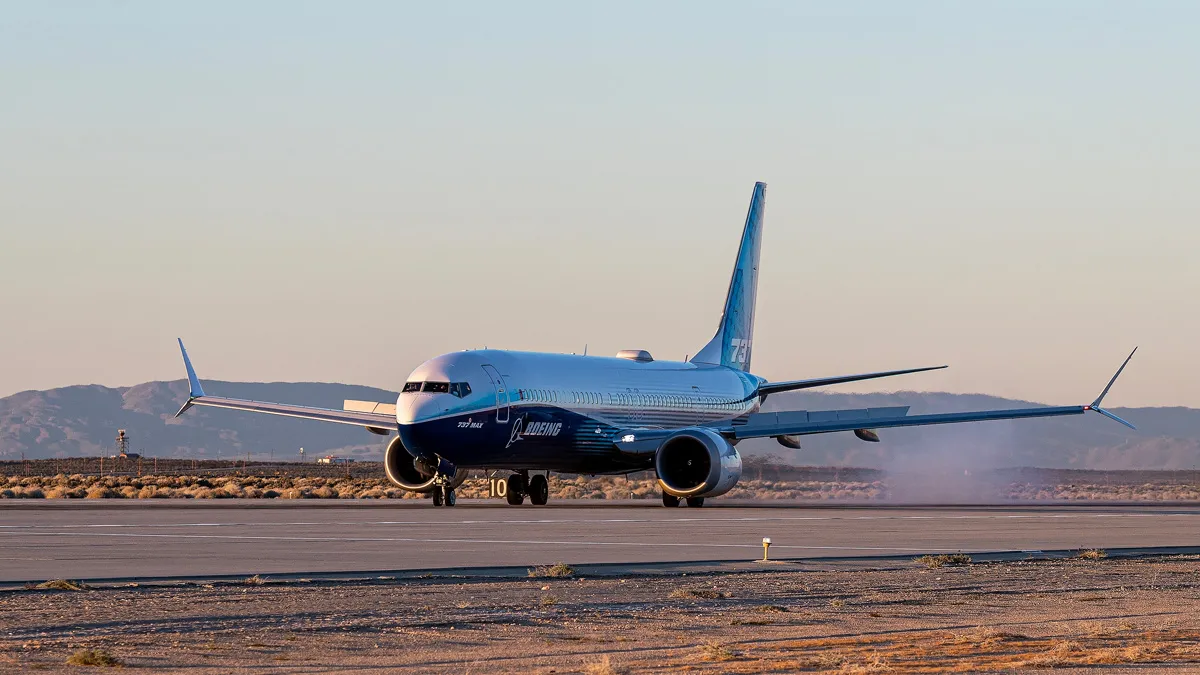
Boeing has completed maximum brake energy (MBE) certification testing on the 737-10, the largest member of the 737 MAX family, with two rejected-takeoff runs at Edwards Air Force Base in California. The test, detailed in a Boeing feature published April 21, 2026, required test pilots to bring a fully loaded airplane traveling at more than 200 mph to a complete stop using worn brakes alone, without thrust reverser assistance. The MBE milestone clears one of the more demanding hurdles on the path to type certification.
Highlights
- Test airplane was loaded to its maximum takeoff weight of 197,900 pounds (89,765 kg), with brakes machined to within 2 percent of their wear life
- Aircraft accelerated to 180 knots (207 mph / 333 km/h) before pilots cut throttles and applied brakes only
- Stopping distance was approximately 11,000 feet on a 15,000-foot runway, with brake temperatures exceeding 2,500°F (1,371°C)
- Two separate MBE runs were conducted to certify both 737 MAX brake suppliers; Boeing targets 737-10 and 737-7 certification later in 2026
What the Test Required
The MBE test is structured to replicate the worst-case rejected takeoff. Crews loaded the 737-10 to its 197,900-pound maximum takeoff weight and machined the brakes down to within 2 percent of their permitted wear life before the run. A three-mile taxi was completed before the takeoff roll to simulate a full gate-to-runway operation, adding heat to the brakes before the stopping event.
Capt. Kevin Zeznick, who flew the test, described the rationale for the worn-brake requirement. “The worn brakes are actually a requirement to show the worst possible scenario,” he said. “We load the airplane up as heavy as it can go and go as fast as it would typically go on any takeoff and show that the airplane can stop and remain safe.”
Hardware Changes on the 737-10
To handle the longer fuselage and higher takeoff weight, Boeing engineers strengthened the 737 MAX braking system and modified the landing gear. The redesigned brake includes a fifth rotor and a longer torque tube to deliver greater clamping force and shorter stopping distances.
“This is certainly the highest-performing brake we’ve ever put on a 737,” said design engineer Evan Preston. “We added a fifth rotor to the brakes and a longer torque tube to get greater brake force and better stopping performance.”
Better stopping performance translates directly to operational flexibility, according to Colston Polly, a 737-10 certification engineer. “For each takeoff, we have to look at what our brake performance is so we know the airplane can stop even if something goes wrong during the takeoff,” he said. “So, whatever we do now, whatever performance we can get could be more benefit to our customers, like being able to be carry more passengers or fly more cargo.” The 737-10 seats up to 230 passengers, ten more than the 737-9.
Heat, Fuse Plugs, and the Five-Minute Hold
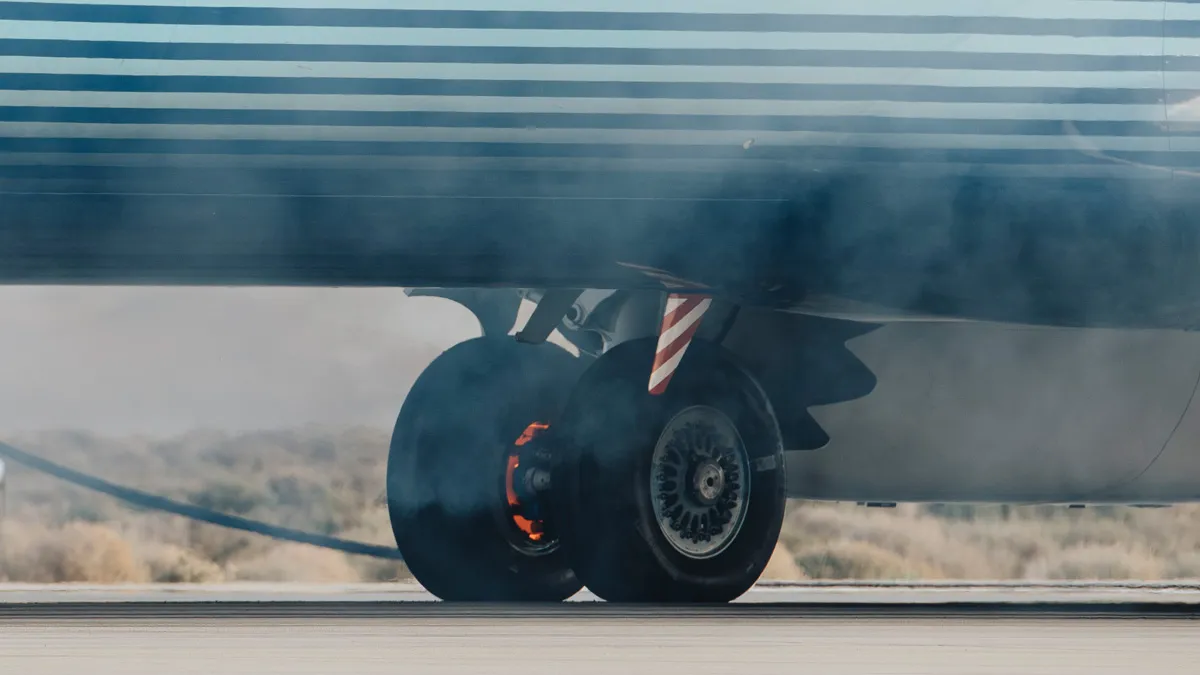
Zeznick brought the airplane to a stop at roughly the 11,000-foot mark on a 15,000-foot runway. After the stop, the test crew held position for five minutes — the standard certification interval representing the time required for airport rescue services to reach a disabled aircraft. During that hold, brake temperatures climbed above 2,500°F (1,371°C).
The 737-10 wheels are fitted with multiple thermal fuse plugs designed to melt at a target temperature and release tire pressure in a controlled manner, preventing tire rupture. All four brakes survived the maximum energy load for the full five minutes before fire crews intervened to cool the assemblies.
Flight Test Engineer Lauren Auerbach, who served as a ground observer, summarized the result. “The brakes performed as designed,” she said. “We got the expected brake pressure and the maximum brake energy, and the anti-skid [function] performed as expected.” Zeznick added: “The acceleration and the stopping distances were very close to predictions. So, the airplane performed exceptionally well.”
Two Suppliers, Two Tests
Because the 737 MAX program uses two brake suppliers, Boeing was required to repeat the MBE sequence to qualify each supplier’s hardware. After each run, ground crews jacked the airplane, removed the deflated wheel-and-tire assemblies, and swapped in a new brake set so the aircraft could be towed clear of the active runway. The dual-supplier model on the 737 MAX has previously been documented in coverage of Safran Landing Systems’ role on the 737NG and 737 MAX, and Safran has continued expanding its Boeing brake business with recent agreements on the 787-9.
Boeing said both MBE runs met or exceeded predicted performance. The 737 MAX Development team is working through the remaining certification flight tests and documentation, with the goal of certifying both the 737-10 and the smaller 737-7 later this year.
Subscribe to The BRAKE Report. Get free sample chapters.