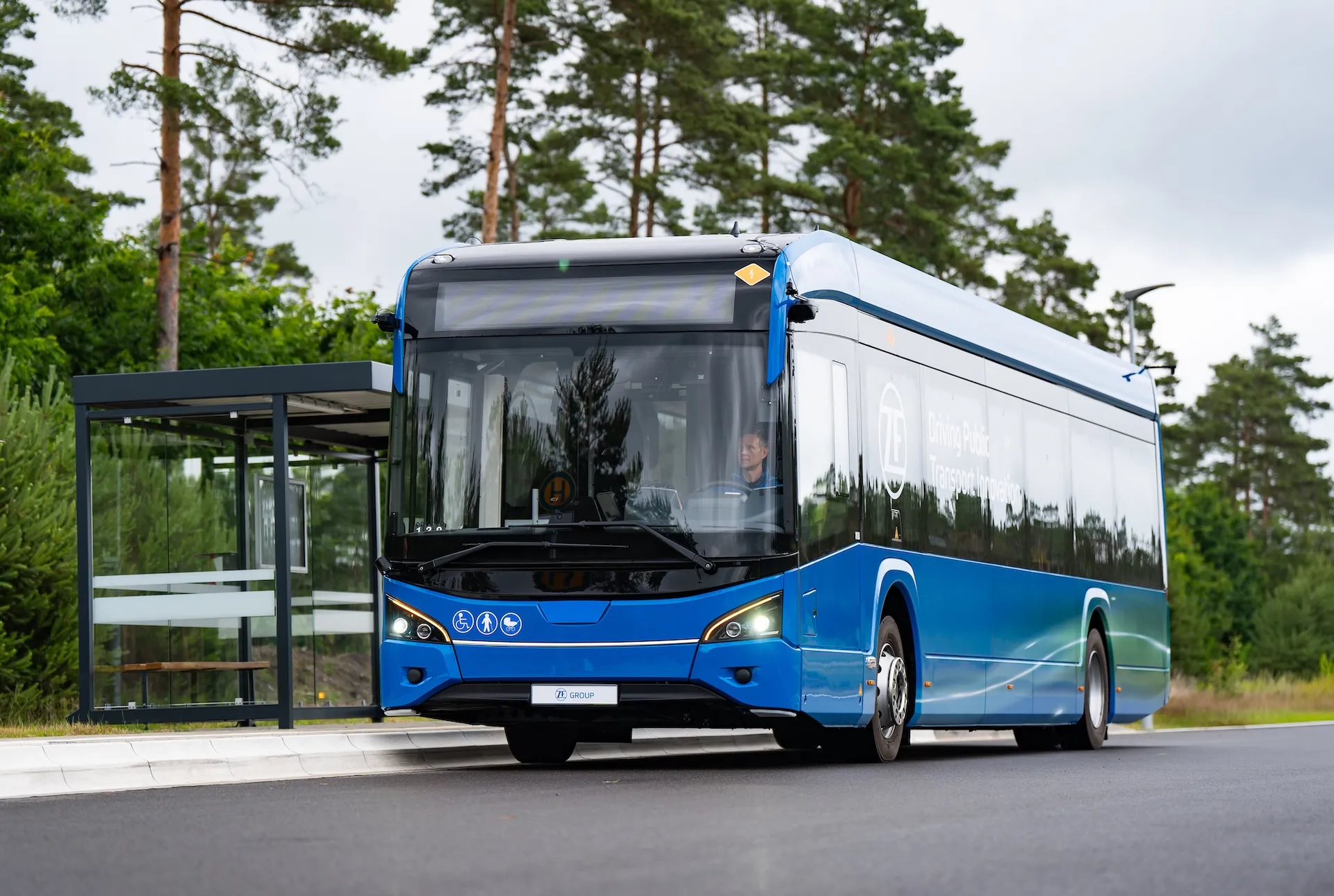

ZF demonstrated City Bus CMS, a collision-mitigation system that applies active braking with a bus-specific braking profile designed to protect standing passengers while helping avoid frontal collisions. The system featured on a fully electric low-floor city bus with an approximately 432 kWh battery at ZF’s CV Tech Day 2026 near Hanover, integrated with steering, suspension, and ADAS functions. ZF says the coordinated control improves safety and accessibility without changing the vehicle’s basic architecture.
Highlights
- Collision mitigation: City Bus CMS combines camera and radar detection with active braking, applying a bus-specific braking profile to reduce risk to standing passengers.
- Bus stop assistance: City Bus Assist steers to reduce the horizontal gap to the curb and uses OptiRide ECAS to control kneeling for barrier-free boarding, while reducing lateral tire scrub and infrastructure damage.
- Ride control: CDC Skyhook adapts damping in real time through a software-based algorithm fed by external sensors and CAN signals.
- Electric platform: The demonstrator is a low-floor city bus seating roughly 30 + 4 with an approximately 432 kWh battery and an oil-free e-comp Scroll air compressor for low-noise operation.
A Bus-Specific Approach to Collision Mitigation
City buses operate in dense urban traffic with vulnerable road users, frequent stops, and standing passengers, where emergency braking itself can create injury risk inside the vehicle. City Bus CMS combines detection from camera and radar with active braking to mitigate or avoid frontal collisions, and applies a bus-specific braking profile intended to reduce the risk to standing passengers during an intervention. ZF first introduced its city bus collision mitigation system for this market segment, extending its commercial-vehicle braking and ADAS experience to urban transit.
Assisting the Bus Stop Approach
City Bus Assist is a perception sensor-based function that supports precise bus stop approaches. It steers actively to reduce the horizontal gap to the curb while minimizing lateral tire scrub, and works with OptiRide ECAS suspension control to optimize kneeling and reduce the vertical entry gap for barrier-free boarding. ZF says the function reduces infrastructure and tire damage and improves vehicle uptime.
Comfort, Accessibility, and Electrification Beyond the Driveline
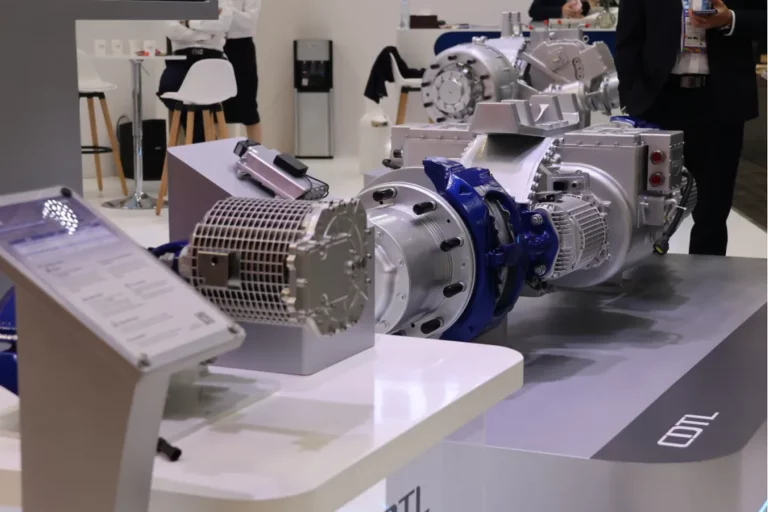
Continuous Damping Control (CDC) Skyhook continuously adapts damper characteristics in real time to road and driving conditions to improve stability and ride comfort. ZF also extends electrification beyond the driveline with the e-comp Scroll air compressor: because compressed air remains essential for service brakes and suspension on electric buses, the oil-free unit supports low-noise operation, eliminates the need for lubrication, and avoids oil contamination. Core systems — steering, braking, the electrified driveline, and ADAS including City Bus CMS — are based on existing ZF series technologies, with City Bus Assist and CDC Skyhook added through software-driven integration on the existing platform. ZF’s electric bus drivelines are detailed in its CeTrax production milestone.
“With smart integration of ADAS, steering, braking and chassis functions, we bring safety and comfort on an existing vehicle platform to the next level,” said Christoph Barth, Global Innovation Domain Automation & ADAS Engineer at ZF.
Maximilian Lenz, System Expert for Innovation ADAS, Perception & Intelligence, added: “City Bus Assist supports drivers during bus stop approaches by combining perception, steering and suspension into one integrated system, reducing damage and related costs while improving accessibility for passengers.”
ZF presented the bus as a technology demonstrator and said it will preview the technologies at IAA Transportation 2026 in Hannover, September 15–20, 2026.
Subscribe to The BRAKE Report. Get free sample chapters.