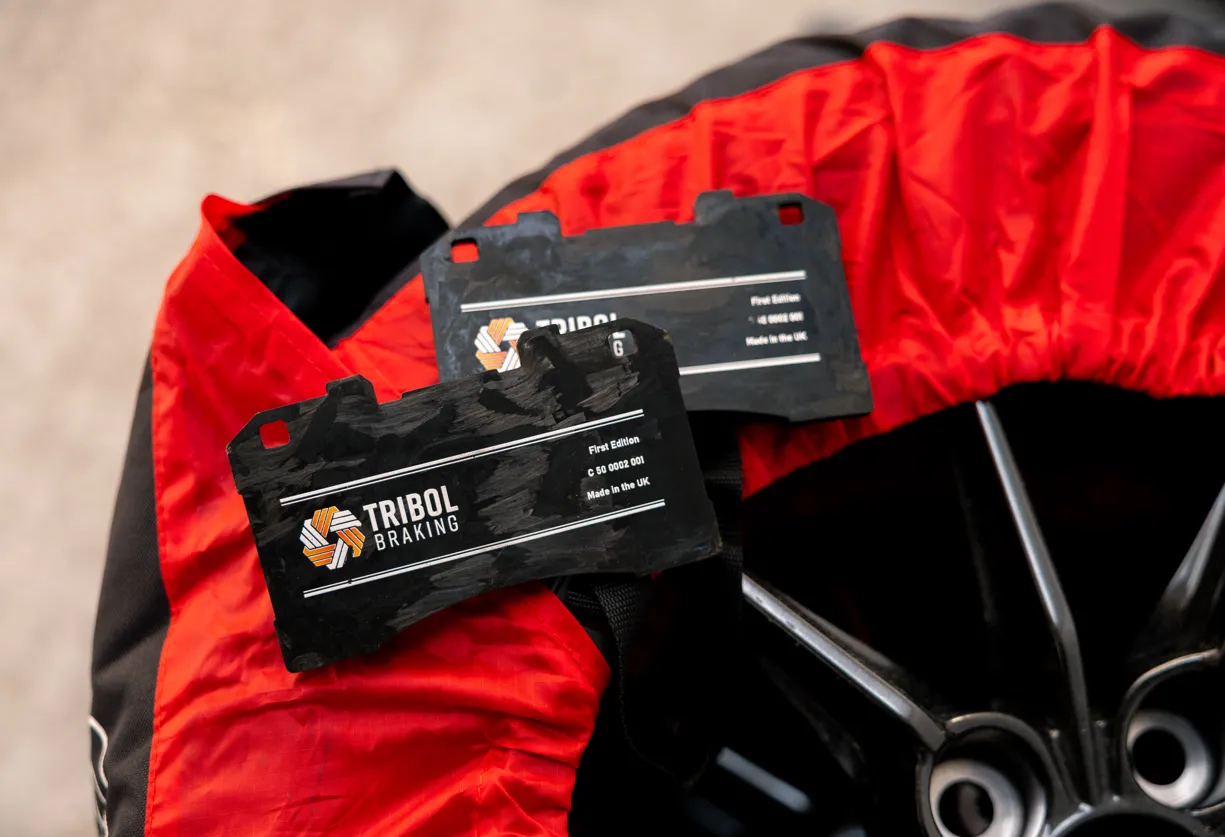

UK-based Tribol Braking plans to bring the first commercially available full-composite brake pad to market in summer 2026, replacing the conventional steel backing plate with an advanced carbon-fiber composite. The product, built around the company’s proprietary ColdForge-Carbon material, will debut publicly at EuroBrake 2026 in Mainz, Germany, with motorsport and track-day applications targeted first.
Highlights
- Backing plate is 70% lighter than steel, reducing unsprung mass at each corner
- Composite material is 65 times more thermally insulative than steel, limiting heat transfer to brake fluid and calipers
- Cradle-to-grave analysis shows a 60% reduction in CO2e for standard pads, with mass-market variants reaching up to 74%
- Public debut scheduled for EuroBrake 2026, June 1–3 at the Rheingoldhalle in Mainz, Booth 17
Why a Composite Backing Plate Matters
The brake corner has steadily shed mass over the past decade. Aluminum calipers are now common on EVs, and carbon-ceramic (CSiC) discs continue to gain ground at the premium end. The backing plate, however, has remained stubbornly steel. Composite alternatives have been pursued since the 1970s, but thermal tolerance and stiffness at elevated temperatures have repeatedly defeated the concept.
Tribol says its ColdForge-Carbon material, developed over eight years, addresses both barriers. The company describes the material as a fibre-reinforced modified phenolic, drawn from a family of composites originally developed for NASA re-entry heat shields and adapted for braking duty cycles.
Reducing unsprung mass carries a disproportionate effect on vehicle dynamics and EV range compared with sprung mass mounted inboard of the suspension. Tribol also points to corrosion resistance as a key benefit — particularly relevant for regen-braked electric vehicles, where pads see reduced duty cycles and corrosion has emerged as a leading cause of replacement.
Thermal Performance and Brake Fade
The thermal insulation claim is central to the value proposition. Heat transfer into the caliper and brake fluid is a primary contributor to fade, expanding the fluid and producing a “long” or spongy pedal. In severe cases, fluid boiling can lead to brake failure.
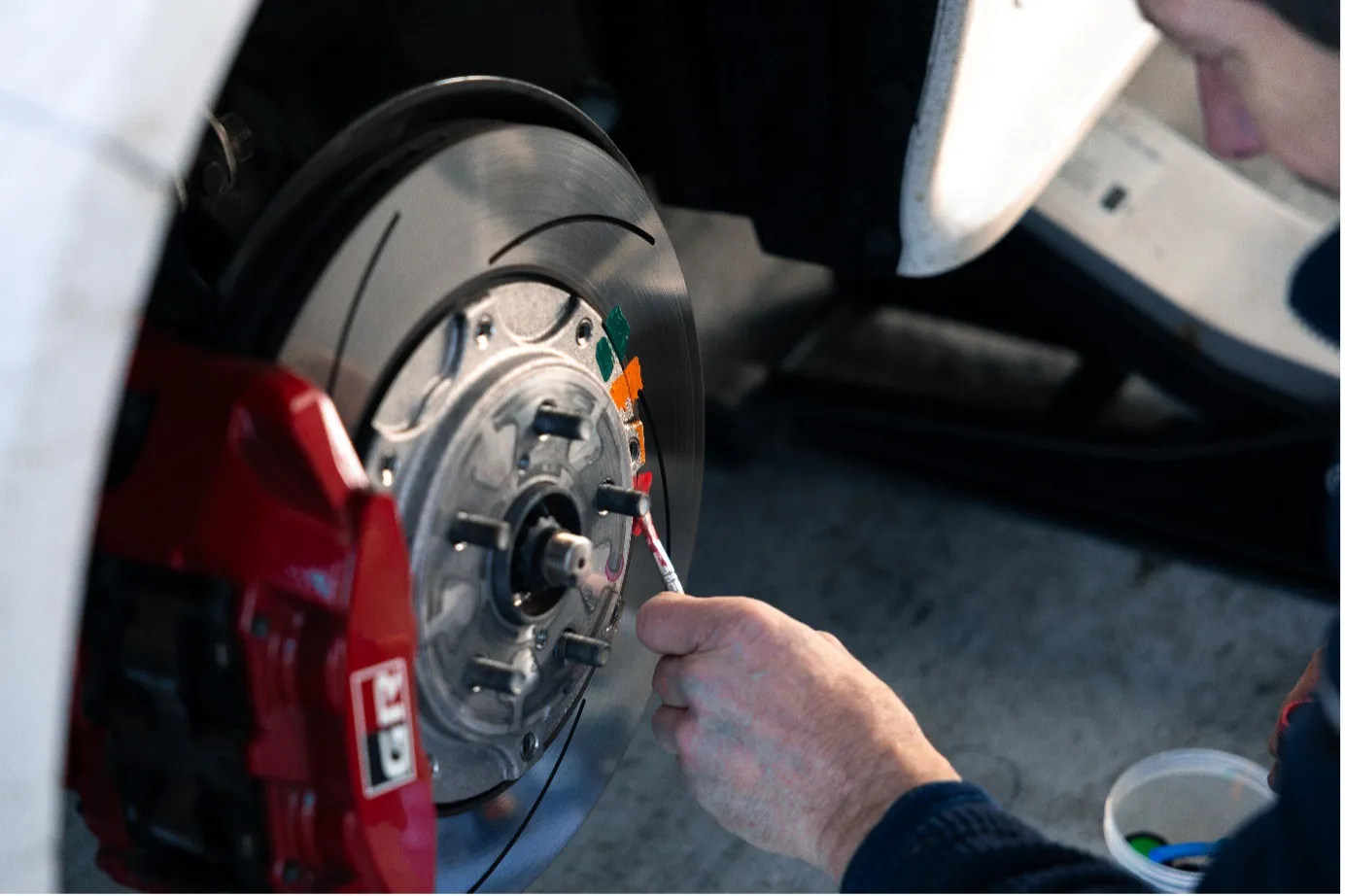
Tribol reports that race-pace track testing eliminated these symptoms even where disc temperatures sustained above 700°C. The insulating effect, the company adds, also reduces caliper seal aging and paint fade. Independent third-party verification of these test results was not provided in the launch material.
The pad design integrates a mechanical retention feature molded into the plate itself, gripping the friction puck to prevent debonding. Tribol claims shear values that rival the highest in the industry, though specific numerical comparisons were not disclosed.
Manufacturing and Path to Scale
Unlike CSiC disc production, which depends on specialized infrastructure and energy-intensive processes, composite pad manufacturing fits within existing brake-industry tooling. Tribol is working with several manufacturing partners to model production scaling, including IAG Industrie Automatisierungsgesellschaft m.b.H., an Austrian press-equipment specialist that holds roughly 60% market share in Europe and one-third globally for friction-lining presses.
A cradle-to-grave life-cycle analysis cited by Tribol shows a 60% CO2e reduction for standard pads versus steel, with mass-market variants potentially reaching 74%. Methodology details for the LCA were not included in the launch announcement.
Initial Market and EuroBrake Debut
Track-day and motorsport applications will lead the rollout. The primary draw for that segment, according to Tribol, is the sustained braking performance enabled by control of fluid-related fade — allowing later braking points and more consistent lap times over longer stints.
Tribol’s pads will be on display at EuroBrake 2026 at Booth 17. The company indicates a range of designations will be available from summer 2026 onward, with mainstream automotive applications a longer-term ambition. Pricing was not announced.
Subscribe to The BRAKE Report. Get free sample chapters.