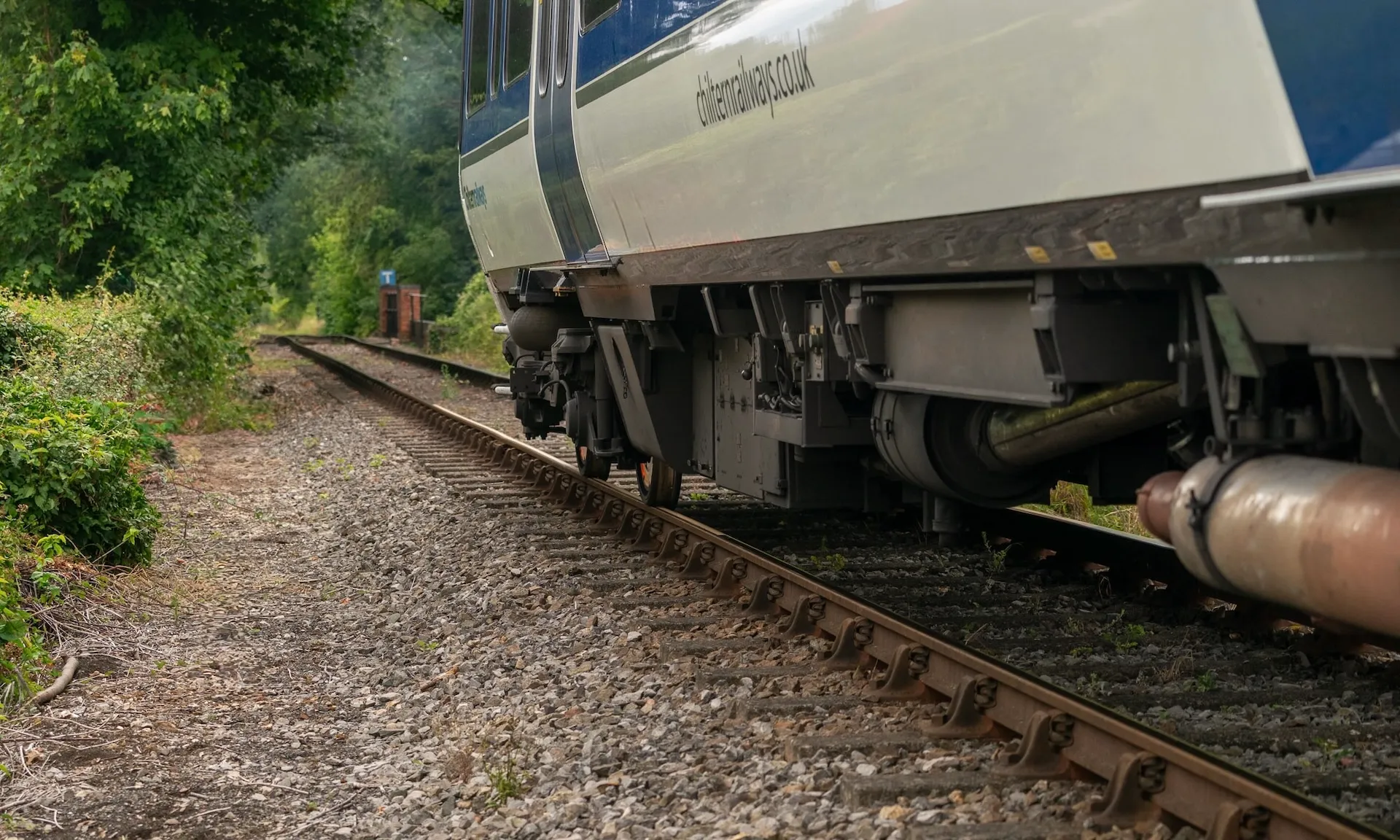

Knorr-Bremse Rail Systems UK and Chiltern Railways have extended their railhead low adhesion monitoring trial by 12 months, carrying the program through August 2027 and into a second autumn leaf fall season. The system was jointly developed by Knorr-Bremse and Chiltern Railways with support from Angel Trains, and runs on a Class 165 unit working the Chiltern Main Line and the London to Aylesbury route. The extension is intended to prove the real-world concept of capturing richer data while the technology is refined and engagement across the rail industry expands.
Highlights
- The trial, originally launched in August 2025, now runs through August 2027 under a 12-month extension.
- Instrumented Class 165 unit 165004 has recorded more than 500 wheel slide events and 850 traction slip events since entering passenger service in September 2025.
- The system calculates wheel-rail adhesion values during braking, including in the moments immediately before and after a WSP activation.
- Low adhesion hotspots have been located to within a few meters, with adhesion variation tracked between individual axles during braking.
What the System Measures That WSP Alone Cannot
Conventional equipment indicates only that wheel slide or traction slip has occurred. The Knorr-Bremse system calculates wheel-rail adhesion values during braking events, notably in the moments before and after a wheel slip protection (WSP) activation — an insight the industry did not previously have. That allows engineers to assess the actual condition of the railhead and determine how slippery it is in operational service.
Since entering passenger service in September 2025, the instrumented unit has continuously captured adhesion, braking, wheel slide and traction data without affecting normal operations. The first year of the trial covered a range of operating conditions, including autumn leaf fall and adverse weather, and enabled engineers to identify low adhesion hotspots with an accuracy of just a few meters while monitoring variations in adhesion levels between individual axles during braking.
John May, Digital Services Business Development Manager at Knorr-Bremse Rail Systems UK, said the dataset changes what operators can act on: “Data collected through our railhead low adhesion monitoring system has the potential to provide rail industry customers with a much clearer understanding of not only when low adhesion has occurred, but also where it is happening and what action may be needed to address it.”
Data Feeding Industry Research
The high-resolution data is also supporting the work of the Rail Safety and Standards Board’s Adhesion Research Group (ARG) and wider industry research into low adhesion behavior.
According to May, extending the trial strengthens that dataset. “As the trial enters its second year, our team believes the technology has the potential to transform how low adhesion is understood and managed across the UK rail network, enabling smarter interventions, more targeted railhead treatment and improved operational performance during challenging seasonal conditions,” he said.
What the Second Year Targets
Louis Schmandt, Technical Engineer at Chiltern Railways and project lead, said the first year advanced both the data processing and the user interface, with analysis now possible at network level and at individual incident level.
“Adhesion hotspots have been identified in areas that were not previously considered by Chiltern and Network Rail and a lot of progress has been made in better understanding the kinematics behind low adhesion events – in particular in the milliseconds in the lead up to and immediately following a WSP activation,” Schmandt said.
The stated objective is a model that acts as the industry’s primary means of predicting low adhesion risk at any location and time of year. “The next challenge will be to build on this capability and enable the WSP system to proactively utilise this data to directly control the train’s response to low adhesion, thereby reducing dependence on infrastructure mitigation measures or driver behaviour,” Schmandt said.
Scaling Beyond a Single Unit
Schmandt also argued for widening the deployment: “There is now a strong case to scale up this trial to include additional units both at Chiltern and across other networks.” Broader deployment, he said, would demonstrate the concept’s value both in predicting low adhesion risk for operators and infrastructure managers and in providing technical insight for incident investigations and delay attribution.
Subscribe to The BRAKE Report. Get free sample chapters.