
Knorr-Bremse will present a digital-electromechanical rail braking system built on brake-by-wire that removes hydraulics from the architecture entirely, one of the featured exhibits at an InnoTrans 2026 stand spanning roughly 14,500 square feet (1,350 square meters). The supplier is grouping its on-train braking exhibits under the theme “Evolution of Braking,” pairing the electromechanical system with continued development of the electropneumatic brake it describes as the current global standard for train braking. The broader lineup covers coupling, air supply, boarding, and AI-based diagnostics and driver assistance.
Highlights
- Booth footprint: approximately 14,500 square feet (1,350 square meters) in Hall 1.2, Booth 250, plus a dedicated embedded electronics booth in Hall 27, Booth 740
- ScrewSupply Eco compressor: lifecycle costs reduced by up to 40 percent, according to Knorr-Bremse
- Smart Integrated Functional Unit (SIFU): onboard wiring cut by more than 70 percent, the company reports
- ZeroStepBoarding: door threshold reduced to as little as 0.35 inches (nine millimeters)
Two Braking Development Tracks
The digital-electromechanical system, marketed as Brake-by-Wire, is positioned for higher performance, improved energy efficiency, and lower lifecycle costs through full electrification and the elimination of hydraulics. In parallel, Knorr-Bremse continues to develop the electropneumatic brake, or Brake-by-Air. Underpinning both is the new nX system architecture, which the company says enables software-defined solutions and the integration of customer-specific, data-driven functions in an environment with the highest safety requirements.
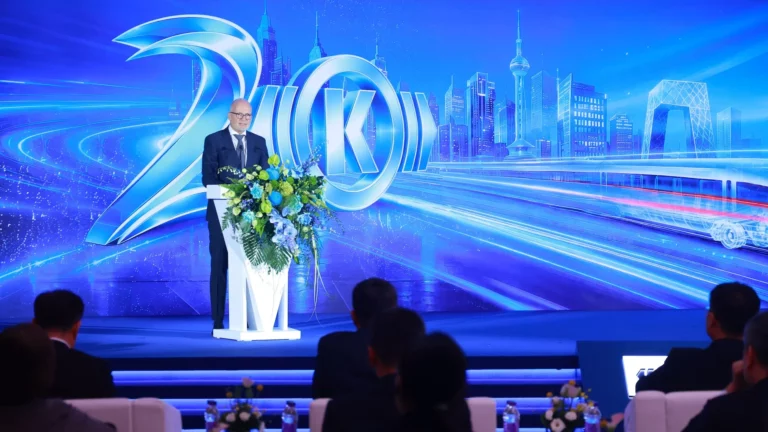
“At InnoTrans, we are demonstrating how we are rethinking the rail ecosystem and bringing greater performance and efficiency to the tracks with new generations of safety, digital, and vehicle technology,” said Dr. Nicolas Lange, member of the Executive Board of Knorr-Bremse AG and globally responsible for the Rail Division. “At the same time, we are connecting rolling stock and infrastructure more intelligently through smart electronics, new software, and digital signaling and control solutions. This enables our customers to operate their fleets and networks even more efficiently. The result: greater capacity, higher availability, and tangible benefits for passengers and freight operators.”
Freight Automation and Driver Assistance
The Digital Automatic Coupler program centers on the DAK Type 5 with the Knorr-Bremse e-Coupler, which establishes a train-wide data and power connection supporting automatic coupling, automatic brake testing, train formation, and remote uncoupling. Paired with the FreightControl Suite and FreightControl Sentinel, it forms the basis of what the company calls the Digital Freight Train, covering both DAK-based and wireless approaches. For passenger rail, the front- and center-buffer couplers AutoLink and ShortLink remain in the portfolio.
On the assistance side, LEADER Flow uses real-time traffic and route data to generate predictive driving recommendations, delivering energy savings in the double-digit percentage range and already in customer service, according to Knorr-Bremse. LEADER AutoControl, deployed in markets including the United States and Australia, targets energy consumption, braking performance, and operational efficiency on the heaviest freight trains.
Friction Pairing, Air Supply and Energy Management
Sustainable Friction Pairing addresses the brake pad and brake rotor as a matched system, with the company citing effects on CO₂ footprint, particulate emissions, material compliance, circularity, and in-service energy efficiency. Material combinations and design variants vary by application.
AirSupply Smart adjusts compressed air delivery to the braking system on demand. Combined with the ScrewSupply Eco compressor and DrySupply Compact air dryer, Knorr-Bremse reports reductions in noise, maintenance, weight, and installation space. The SIFU consolidates control, diagnostic, and measurement functions for energy distribution into a single unit, with a new SIFU AC variant for alternating-current vehicles.
Passenger Systems and Digital Services
For regional and commuter trains, the ZeroStepBoarding system pairs with the E4 double-leaf door system to enable near step-free boarding meeting European and American accessibility requirements. The TouchlessBoarding sensor, ProDect 2S anti-pinch system, and Select door control unit add contactless entry, cybersecurity, and condition monitoring. The Next Generation Toilet monitors vacuum, pressure buildup, and tank levels in real time to support condition-based maintenance.
Under the X.Sectional banner, the Duagon and Selectron brands supply computing, control, and train communication network products. Railnova analytics apply AI to fleet telemetry for remote diagnostics, and Knorr-Bremse is a participant in the European Rail Data Space. Through RailServices and digital partner EYYES, the company is introducing RailEye Front Collision Warning for metro, tram, and light rail, in which intelligent cameras detect obstacles and people in the track area, alert the operator, and can trigger automatic braking if no response follows.
Where to Find Knorr-Bremse at InnoTrans
| Booth | Hall and Stand | Focus |
|---|---|---|
| Knorr-Bremse main booth | Hall 1.2, Booth 250 | On-Train, Wayside and X.Sectional portfolios |
| Embedded Electronic Solutions | Hall 27, Booth 740 | Embedded electronics, computing and control |
| Europe’s Rail | Hall 4.2, Booth 250 | DAK and digital-electromechanical braking |
| CityCube (Gruppo FS) | Hall B, Booth 610 | DAK for automated rail freight |
Subscribe to The BRAKE Report. Get free sample chapters.