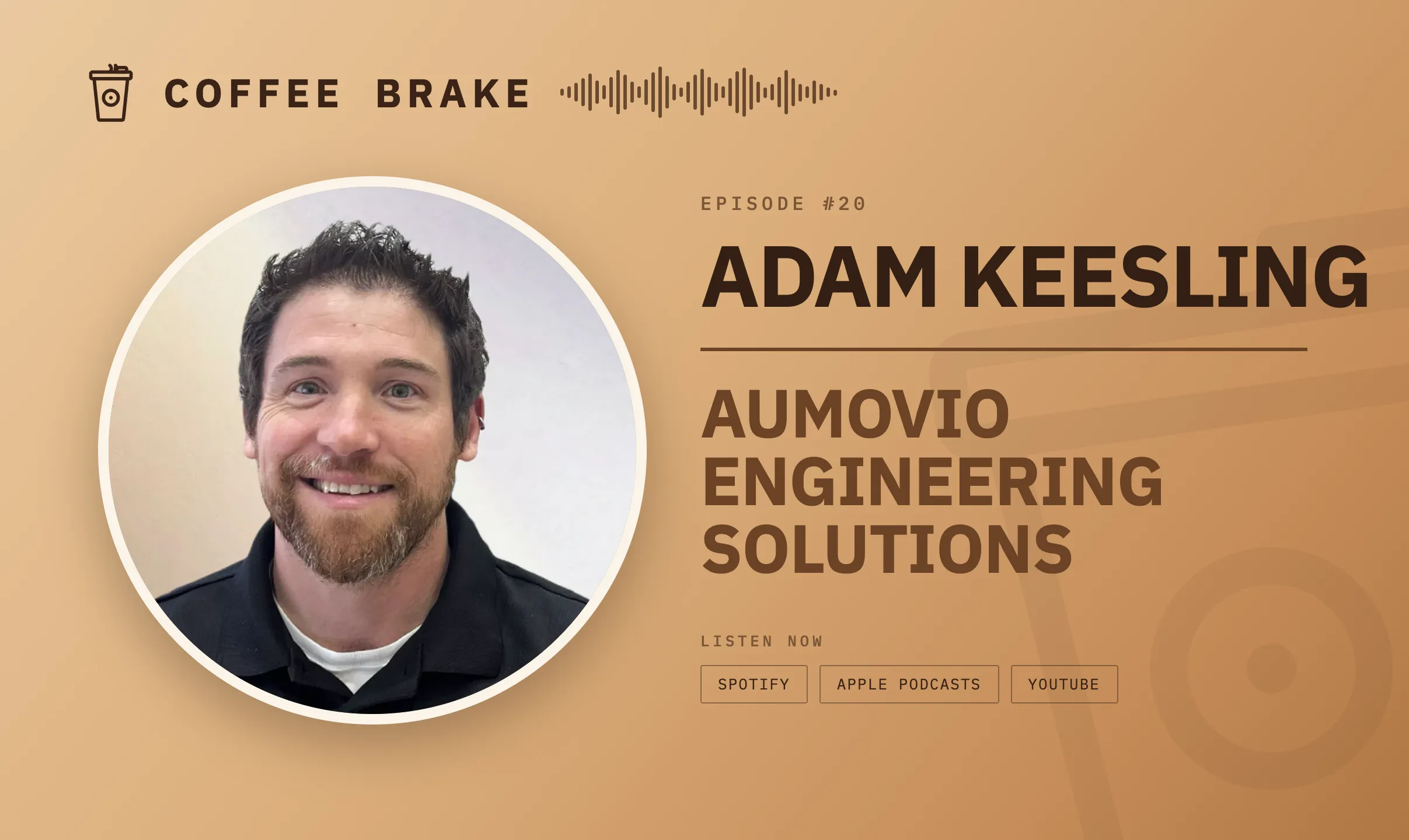

AUMOVIO Engineering Solutions is bringing the electronic brake control technology behind AUMOVIO’s 500 million delivered electronic brake systems to side-by-sides and other powersports vehicles, according to Powersports Program Manager Adam Keesling. In the latest episode of the Coffee Brake Podcast, Keesling tells host Brian Hagman that the core brake control functions carry over from passenger cars almost entirely. The engineering work, he says, lies in adapting them to how off-road machines are actually driven. The conversation also covers the unit’s low-volume business model, the trade-offs of ABS on lugged off-road tires, and whether regulation or the market will drive adoption first.
Highlights
- 500 million units: AUMOVIO’s electronic brake systems passed 500 million deliveries last year, built on controllers Keesling says were developed at high volume and to automotive standards over roughly 40 years.
- 200+ hp machines: Several side-by-sides now exceed 200 hp, including one on sale at 275 hp and 92 mph that is not required to carry the electronic controls mandatory on passenger cars since 2012.
- Separate NRE and hardware: The unit charges nonrecurring engineering separately from hardware, so development cost is not amortized into piece price.
- European ABS mandate: Europe’s T1b fast-tractor category, which many of these vehicles are homologated under, already requires ABS, according to Keesling.
What Does AUMOVIO Engineering Solutions Do?
Keesling describes the unit as an engineering service provider, typically hired by a vehicle OE to integrate or adapt a product or technology. Its distinguishing role, he says, is serving as the access point into the broader AUMOVIO product portfolio for non-traditional customers whose volumes don’t support an automotive business case.
In practice, the unit supplies mostly engineering resources: scope of work, development, and integration. It then facilitates hardware procurement through AUMOVIO’s component suppliers.
The commercial model is built around small customers. AUMOVIO Engineering Solutions charges nonrecurring engineering (NRE) for development activities and sells hardware separately, which gives it flexibility on smaller programs. Keesling says the concern about market size came more from prospective customers than from inside the company. Smaller OEs asked whether they would be pushed aside when a larger customer arrived.
“Our target customer is the lower volume, the niche, the non-traditional,” Keesling said. “That is who we are designed to cater to.”
Why Powersports?
A modern side-by-side shares much of its brake architecture with a passenger car: four wheels, four disc brakes, a steering wheel, and a single pedal applied through a tandem master cylinder. “So fundamentally the electronic brake control systems carry over almost entirely,” Keesling said. The differences, he explains, are in how the functions are applied to powersports use cases.
Rising machine prices are also narrowing the gap between what owners spend on a side-by-side and on the daily driver in the driveway. Keesling says that sets an expectation, sometimes subconscious, that technology in one vehicle should appear in the other. He adds that many of the unit’s engineers joined specifically for non-traditional work like powersports. The company would like to see adoption follow the path already seen on two-wheelers.
How Can Brakes Make a Side-by-Side Faster?
Keesling acknowledges that brakes carry an unexciting reputation with riders. His pitch reframes them. “Braking systems can actually make you faster. They actually increase the performance of the vehicle,” he said.
- Brake traction control: Keesling compares it to an intelligently selectable locker. “With the brake traction control system, we can apply brake pressure to the non-tractive wheel, thereby transferring torque through an open differential to the tractive wheel and help the vehicle move forward. So we apply brakes to go.”
- Hill start assist: On machines with a continuously variable transmission (CVT), the industry standard, lifting off the throttle on a steep grade generally produces rollback. The rider’s rushed move from brake to throttle often leads to over-acceleration and wheel spin. Hill start assist traps brake pressure to give the rider time to make that transition. “That feature in and of itself, I think, will sell electronic brake controls,” Keesling said.
The company leads with performance in this market, though Keesling says the framing works in either direction. “We could say it’s a performance system with safety as a byproduct, or we could say it’s a safety system with performance as a byproduct,” he said.
The ABS Trade-Off Off-Road
Keesling calls ABS the most contested feature in the segment. Deep, heavy-lug off-road tires often produce the shortest stopping distances and highest deceleration with fully locked wheels. By that measure alone, ABS can look like a performance loss.
Keesling argues steerability belongs in the definition of braking performance, particularly on tight trails with opposing traffic and poor visibility. “ABS will have marginal losses in decel and stopping distance on many surfaces off road. However, the trade-off is you gain steerability,” he said.
Mode-Based Control and Commercial Fleets
Because powersports lacks the regulation of passenger cars, OEs can let operators enable and disable functions independently. Keesling says AUMOVIO’s electronic brake and chassis control systems support mode-based control, HMI-based switching, or activation through a phone or smart key. A parent, for example, could restrict children to a safety-oriented function set.
Messaging shifts by buyer. Recreational riders resist the term driver aid. “We call it ego-based decision making. I can do it. I don’t need a system to do it for me,” Keesling said. For fleet and commercial users, such as municipalities and campus maintenance crews, the company presents the same features openly as driver aids.
Testing and Durability
Keesling, who comes from an automotive brake test background, says off-road work replaces the repeatable surfaces and regulation-driven targets of proving-ground testing with subjective, customer-driven evaluation. “We recognize that the ride and handling characteristics of these machines is a heavy part of the OE DNA. And we don’t want to dictate that with objective requirements of our own design,” he said.
On durability, he notes that the components are built to automotive standards for a much longer life cycle than a side-by-side’s. The company’s analysis found that even under harsher off-road use, wheel speed sensors, steering angle sensors, and the hydraulic electronic control unit remain well below durability concerns.
Will Regulation or the Market Move First?
Keesling expects both forces to close the gap. In North America, regulatory bodies float proposed rulemaking, and OEs respond by investigating new technology to keep that regulation at bay. “The threat of these regulations and the desire of the OEs to kind of maintain that freedom that is the spirit of powersports, that dance together is what will close this gap, I believe,” he said.
Europe adds pressure from another direction. OEs selling there under the T1b category already have to develop ABS. “So this kind of gives us a strong diving board to jump from for North America, in that some of these OEs are already doing the initial legwork to integrate these systems for European regulation,” Keesling said.
Listen to the Full Conversation
The full interview with Adam Keesling is available on the Coffee Brake Podcast. Keesling points listeners to the AUMOVIO Engineering Solutions website, where the motorsports sector covers the unit’s powersports and two-wheel technologies alongside its motorsports and racing work.