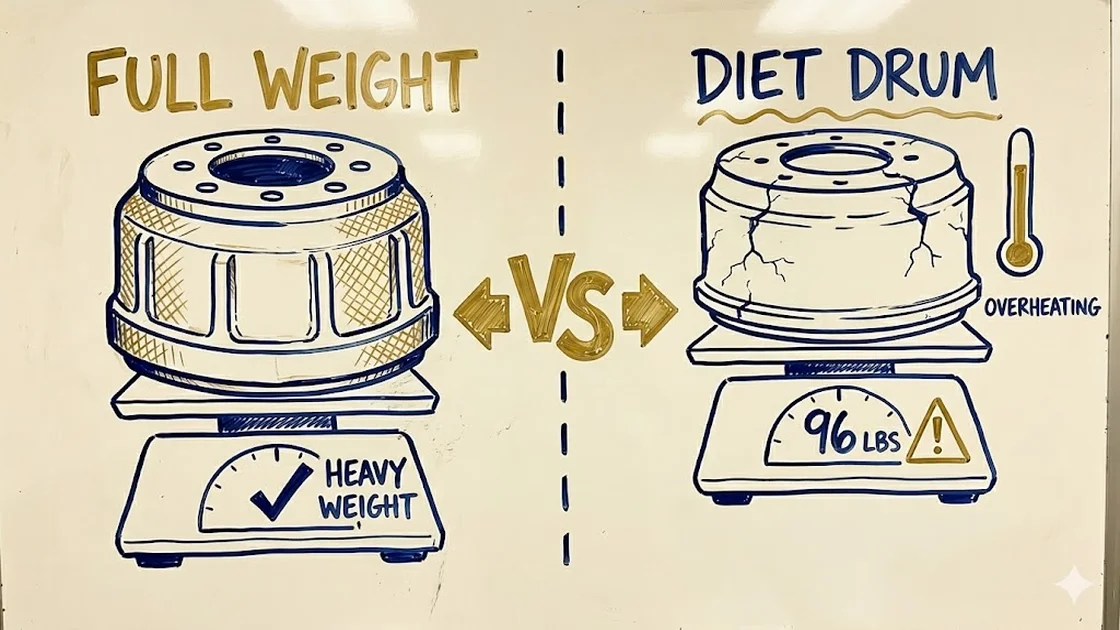

DuraBrake has raised concerns about a growing trend in the commercial vehicle aftermarket: standard cast-iron brake drums that weigh significantly less than traditional specifications. According to the Santa Clara, California-based brake component manufacturer, some heavy-duty drums now weigh as little as 96 pounds — a reduction the company warns carries serious safety and liability consequences.
Highlights
- Reduced drum mass limits heat absorption, increasing surface temperatures and accelerating friction material degradation during heavy braking events.
- Underweight cast-iron drums lack the engineered containment features of purpose-built steel-shell lightweight drums, raising the risk of cracking under thermal stress.
- Many lightweight drums enter the market without permanent manufacturer markings, creating traceability gaps that shift liability exposure to distributors, installers, and fleets.
- DuraBrake urges the industry to verify drum weights independently and demand permanent labeling from suppliers.
Thermodynamics and Reduced Mass
Brake drums convert kinetic energy into thermal energy during every stop. A drum’s heat capacity is directly proportional to its mass. When manufacturers reduce the amount of cast iron in the mold, the drum’s ability to absorb heat shrinks accordingly.
DuraBrake outlined three consequences of that reduced thermal capacity. First, surface temperatures on both the drum and the brake shoe rise faster. Second, the friction material’s binding resins break down more quickly at elevated temperatures, accelerating wear rates. Third, outgassing from overheated resins can create a gas layer between the shoe and drum surface, producing sudden and severe brake fade.
Cast-Iron Diet vs. Engineered Lightweight Drums
DuraBrake drew a sharp distinction between underweight standard drums and purpose-built steel-shell lightweight drums. Steel-shell designs use an outer steel jacket engineered to contain the drum under extreme thermal and mechanical stress. A 96-pound all-cast-iron drum, by contrast, is simply a standard drum with less material — offering no additional structural reinforcement.
The company noted that steel-shell composite drums have gained traction among OEMs and fleets as a legitimate lightweighting solution, while underweight cast-iron drums represent cost-cutting rather than engineering advancement.
Traceability and Liability Concerns
Beyond the thermal and mechanical risks, DuraBrake flagged a business liability issue. The company said many of these lighter drums enter the aftermarket without a permanent manufacturer’s mark cast into the product. Without traceability, failure investigations cannot identify the original manufacturer.
DuraBrake warned that in many cases, the foundries producing these drums operate offshore without product liability insurance. When a failure occurs, liability exposure falls on the distributors who sold the drum, the shops that installed it, and the fleets that operated the vehicle.
Industry Call to Action
DuraBrake called on the heavy-duty aftermarket to verify drum weights at receiving — regardless of catalog specifications — and to require permanent manufacturer labeling on all brake drums. The company framed the issue as a long-term business risk, arguing that the upfront savings on cheaper, lighter drums are offset by accelerated wear, increased maintenance downtime, and legal exposure.
Subscribe to The BRAKE Report. Get free sample chapters.