
The 2026 Formula 1 power unit regulations have fundamentally reshaped the role of braking in open-wheel racing. With the removal of the Motor Generator Unit-Heat (MGU-H), all electrical energy recovery now depends on the Motor Generator Unit-Kinetic (MGU-K) during braking phases. Telemetry from the China Grand Prix Sprint Qualifying at Shanghai International Circuit highlights the performance gaps this shift has created.
Highlights
- MGU-K output tripled from 120 kW to 350 kW under 2026 regulations, with all energy harvested through braking alone
- Per-lap harvesting targets reach 8.5 MJ, up from 2 MJ in previous seasons, placing extreme stress on braking systems
- Speed trap gaps of 11–17 km/h between Red Bull and Ferrari suggest significant differences in energy recovery calibration
- Active aerodynamics (X-mode and Z-mode) now interact directly with electric deployment strategy on straights
MGU-H Removal Shifts Burden to Braking
The MGU-H previously enabled near-continuous energy recovery from exhaust gases. Its removal means the MGU-K must now harvest up to 8.5 MJ per lap solely through braking. That represents a fourfold increase over prior seasons. The requirement places extreme thermal and mechanical stress on braking systems. It also demands sophisticated energy mapping to keep battery temperatures within operating limits.
“What we are seeing on the long straights of Shanghai is a phenomenon known as ‘derating,'” said Mirko Borghesi, Director of F1-News.eu. “When a driver like Lewis Hamilton reports a lack of power, he is often experiencing the car’s software cutting off electrical deployment to protect the battery’s state of charge.”
Borghesi added that managing energy “clipping” at the end of straights is now as critical as initial acceleration in the 2026 era.
Shanghai Speed Trap Data Reveals ERS Gaps
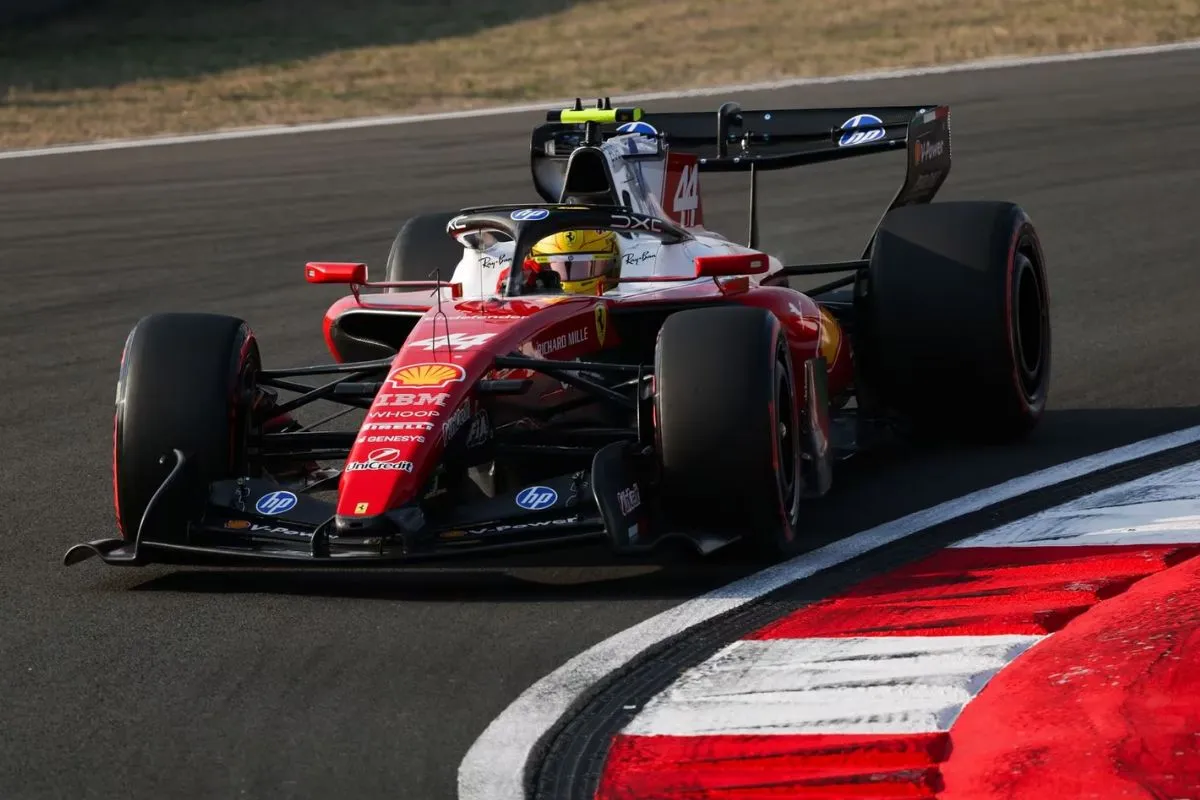
Speed trap data from China Sprint Qualifying showed clear divergence between teams. Isack Hadjar in the Oracle Red Bull Racing car reached 341 km/h. Lewis Hamilton’s Scuderia Ferrari HP peaked at 330 km/h. Charles Leclerc trailed further at 324 km/h.
The 11–17 km/h gap is not solely an engine performance issue. It reflects how each team calibrates its Energy Recovery System (ERS). A car forced to harvest more aggressively during braking to maintain battery charge will sacrifice top-end electric deployment on straights. Ferrari’s drivers reportedly experienced this as a “missing power” sensation.
Active Aero Adds Complexity to Deployment
The 2026 regulations introduce active aerodynamic elements — X-mode and Z-mode — designed to reduce drag on straights. The interaction between movable wing elements and electric deployment timing creates a new optimization challenge. A car that reduces drag more effectively can sustain its 350 kW electric boost longer before reaching its deployment ceiling.
Telemetry suggests Red Bull has achieved a stronger balance between aerodynamic efficiency and energy harvesting cycles. This allowed Hadjar to maintain deployment longer through Shanghai’s 1.2 km back straight.
Road-Car Implications
The battery and power electronics development in F1 paddocks has direct relevance to production EVs. Teams are miniaturizing and optimizing power electronics capable of managing 350 kW of instantaneous deployment. High-density battery cells that can discharge and recharge at the rates demanded by F1 represent a key area of advancement for the broader EV industry.
Subscribe to The BRAKE Report. Get free sample chapters.